


In the wake of the extreme progressivism of recent Doctor Who, a lot of people - myself included - said that the show in its classic era (1963-89) was never this “woke”. Left-wing Whovians disagreed, insisting “it has always been woke!”
Its 1960s era, covering the first two Doctors, is a beast that I just can’t bring myself to enjoy watching. I know this is bad, a sign of ignorance, but life is only so long and there are many other things I need to do with what time I have. Someone else will need to discuss whether it was “woke” in that period.
However, I do very much enjoy what came immediately after: the 1970-1974 era with the Third Doctor, played by Jon Pertwee, overseen by producer Barry Letts and script editor Terrance Dicks. Writers and directors changed from one story to the next, while Letts and Dicks were the mainstays, shaping and steering the show. They were respectively left and right-wing, and together they crafted an adorable programme which, by the standards of today, is very wholesome and old-fashioned.
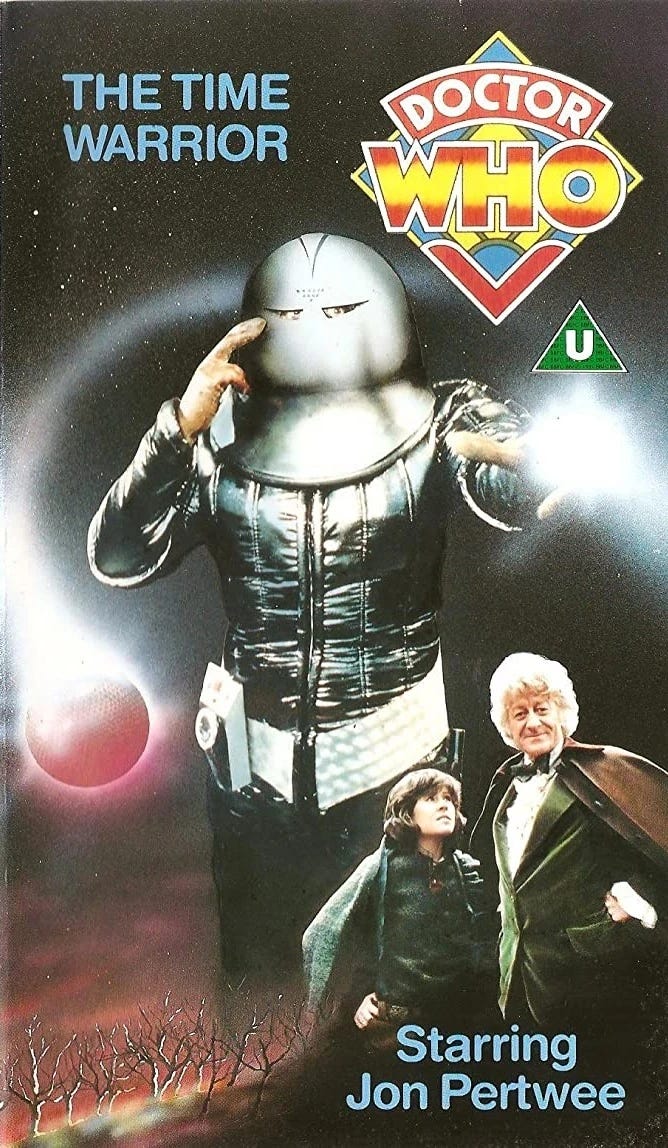
I was first introduced to it in 1989 with a VHS of the story The Time Warrior (which I still think is a lovely piece of lightweight, swashbuckling TV drama) and then two more videos. Throughout the 1990s I saw a few more Third Doctor stories at friends’ houses. From the mid 2000s I slowly gathered the whole run on DVD.
It had been about five years since I last watched any vintage Doctor Who, but then I had these Third Doctor stories playing in the background while I worked on Millenniyule X. This gave me a chance to test the claims of today’s left-wing Whovians - admittedly not about the show’s very beginnings, but still, 56 years ago.
Needless to say, there are no transgender characters. There are no gay characters. There are vanishingly few non-white characters. Feminism is present but, even there, “independent modern women” can be brought to heel by a man if he simply speaks firmly, as occasionally he must do during these perilous adventures. Class receives particularly “regressive” treatment, with the working-class nearly always depicted as gullible, helpless and ignorant.
So, clearly, it is disingenuous to claim that the show in this era was “woke” as we use the term today. But people are talking at cross purposes. Right-wingers mean it wasn’t as ludicrously progressive as it is now, and they are correct. Left-wingers mean it was progressive by the standards of its time, and they are correct.
I will briefly discuss various Third Doctor stories in order to make the point.
Spearhead from Space (1970)
This is the Third Doctor’s debut story, setting up this era of the show. A central feature is UNIT, the United Nations Intelligence Taskforce, a scientific and military organisation which is international in scope and mentality. UNIT is presented throughout this era as a forward-thinking, well-run, thorough and responsible organisation, unlike the British government and the British military which are presented as backward, petty, bigoted, short-sighted, corrupt and often incompetent.
The Ambassadors of Death (1970)
This features a demented British Army general who is driven by his “moral duty” to destroy a peaceful alien race, including by killing dozens of humans who get in his way. He is aided by friends (“the old school tie”) in the British government. He is foiled by UNIT.
The Claws of Axos (1971)
This features a petty, cowardly English civil servant, Chinn, who interferes and sabotages good people. He is desperate to destroy an alien spacecraft before they have shown any signs of being hostile, but is then immediately taken in by their offer of great wealth. He talks about his responsibility to England - the Doctor remonstrating “not to the world?!” - and off-screen says something nationalistic which the Doctor rebukes: “England for the English? Good heavens, man!”
Colony in Space (1971)
This has a planet being settled in 2472 by two sets of humans, one a group of peaceful independent colonists, the other an evil mining corporation. Meantime, the planet has intelligent native species who are low and barbarous now but once had a thriving civilisation which made highly-advanced interstellar weapons, technology far ahead of that of the 25th Century humans.
This story’s anti-imperialist message is less clumsy than that of The Mutants (see below), but my main criticism of that story also applies to this one: to make imperialism look bad, you make the subject peoples look good instead of barbaric. Their apparent barbarism is explained away as a temporary condition, or an illusion caused by prejudice, or even a result of the imperialism itself. No consideration is given to the scenario that they really are barbaric, and a danger to themselves and everyone else, and that their daily life is one of needless hardship and suffering from which they can only be elevated by an imperial power stewarding them. That scenario (of actual, consequential diversity) is apparently inconceivable for the progressive writers of Doctor Who. For them, and their successors working on the show today, diversity is only ever trivial, something that brings harmless and fascinating delights, but never actually matters.
“We’re all the same, really” is the abiding anthem of progressivism. But, for the post-war post-imperial British progressive, the anthem is even more self-sabotaging: “we’re all the same, but, because the barbarian recognises this and we don’t, he is better than us”.
The Curse of Peladon (1972)
This “examines” whether Britain should join the European Economic Community (the EU) via the allegory of a primitive planet joining an advanced federation. The absurd bias should already be clear, but I have written a dedicated essay.
The Sea Devils (1972)
Echoing Chinn from The Claws of Axos, this story has Robert Walker, a trigger-happy English politician who is just desperate to genocide an alien race and is a pathetic coward, as well as selfish, self-aggrandising, foolish, impractical, and eager to blame others for his mistakes. This is how “the British Establishment” is represented here.
Meantime there is Colonel Trenchard, whose defining feature is said to be his patriotism, but his patriotism is used to trick him into helping evil.
Taking Walker and Trenchard together, patriotism is shown to be - only - a weakness.
Countering this somewhat is the Royal Navy as an institution, which is actually shown to be very efficient and well-run. That its staff may be motivated by patriotism is never contradicted, but also never acknowledged.
The Mutants (1972)
This is by far the most egregious, warranting a dedicated essay.
The Time Monster (1972)
A pioneering scientific team has a female member, Dr Ruth Ingram. She mocks her male colleagues for their chauvinism and, when eventually she gets control of the project, outshines them in imagination and competence. The implication is that inside every downtrodden, sidelined female scientist is a Marie Curie desperate to get out, if just given a chance.
Frontier in Space (1973)
In the 26th Century, Earth’s militaristic one-world government is being goaded into war against the Draconian Empire, a war that would devastate both sides. On Earth, only the Peace Party is working to avert this catastrophe. Though beleaguered and borderline illegal, the Peace Party is global and highly organised. One member says “we have contacts everywhere. Journalists, broadcasters, even friends in the government” - agents embedded in every organ of society, quietly subverting, or waiting for the signal to mobilise.
The Peace Party is represented on-screen by a youth activist (played by an Indian actor) but mostly by its imprisoned leader, Professor Dale.
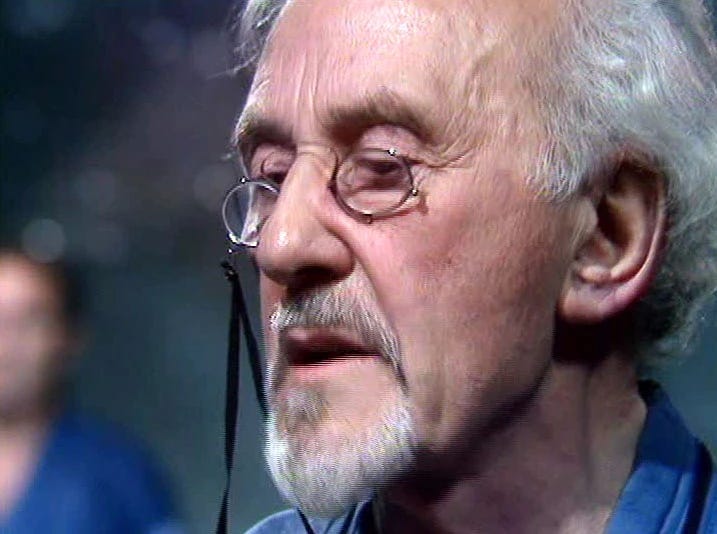
Despite his name, Dale is an extremely Jewish character: an intellectual, an educator, and a dedicated activist who has gone to prison for his ceaseless and courageous struggle for peace. I suspect the actor was consciously chosen, being extremely Jewish himself; his name was Israel Goldblatt! Moreover, this is a very positive portrayal of Jewish political activism: Dale is wise, kindly and intelligent, and uniquely open-minded among the story’s characters. Imagine! All the gentiles we see are feckless and war-like. Thank God that Professor Dale is around to teach them about peace - if only they would listen to him! Instead, they punish him for his intellectual and moral superiority by throwing him in prison!
The Peace Party is an obvious analogue for Comintern, and Dale is an obvious analogue for Trotsky, or really any Jewish intellectual who ever took it upon himself to remake the world and save the goyim from themselves.
This story was written by Malcolm Hulke. He was not Jewish, but given his politics and his writing of the Dale character, I suspect he was in awe of them.
Hulke was a talented writer but also a hard leftist. He was a member of the Communist Party until at least the early 1960s. Whether he stayed a member or not, he remained ardently left-wing and wove messages into his work. In a 1975 letter to a friend, he mocked the conservative establishment for being so naive as to never notice what he was doing:
For seven years running I wrote subversive Doctor Who serials. No one noticed. I’ve since attacked the Right in my Writing for TV in the 70s and in six Doctor Who books. Not a comment.
You would almost think the establishment wasn’t conservative at all. In fact, MI5 had a file on Hulke so must have “noticed” what he was doing, yet let him continue. Boasting of his “subversive” writing, Hulke was pushing at an open door but never realised. He was the naive one.
The Green Death (1973)
A hippie commune of young scientists and activists fight for the environment against an evil corporation, while doing groundbreaking work in the field of ecological science. They are aided in their fight against ruthless capitalism by UNIT.
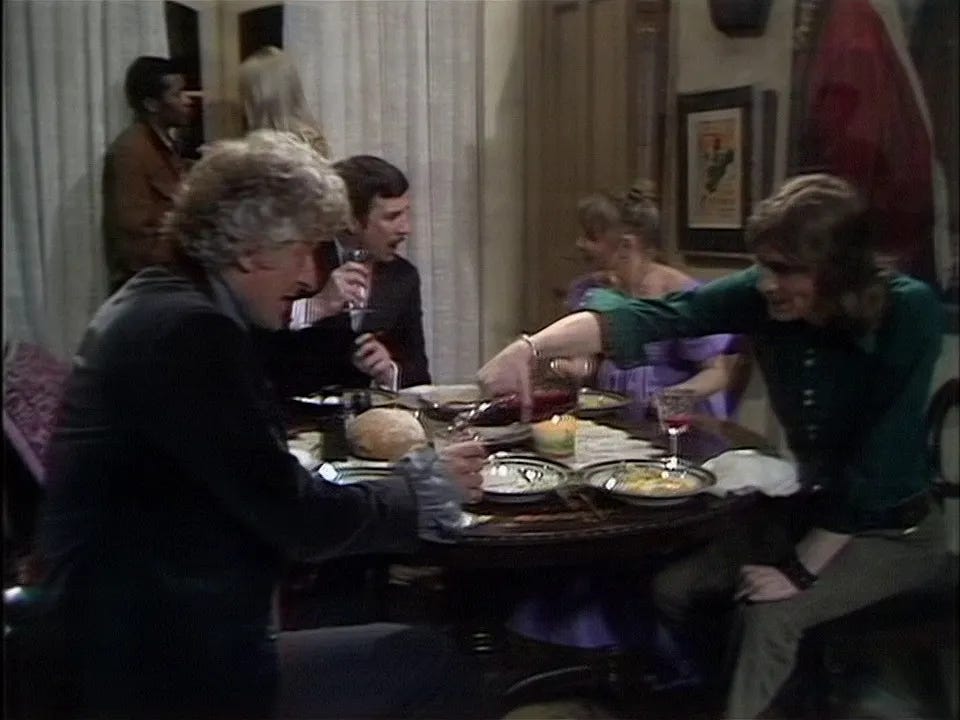
They have house parties in which a Black man (presumably a brilliant scientist like the rest of them) gets close with a beautiful young blonde.
Invasion of the Dinosaurs (1974)
The British government and army are defeated by an internal coup and have to be rescued by UNIT, the embodiment of globalist cooperation and integrity. (However, to be fair, one of UNIT’s officers, Captain Yates, is also involved in the coup.)
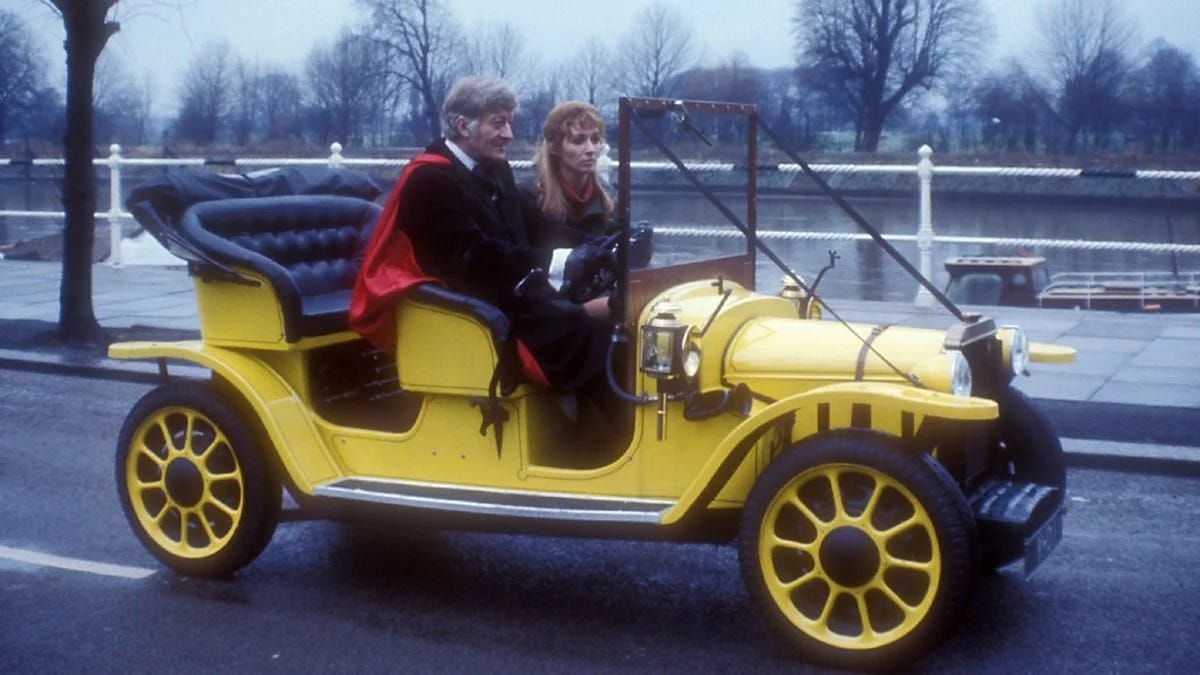
And yet, for all that, early 1970s Doctor Who is still infinitely less “woke” than the programme today.
It accepts without question that men and women exist, are different from each other, and complement each other.
It recommends marriage and family formation as a norm, the only norm.
It shows society being run by hard-headed patriarchs, with women using their wiles to nudge, persuade, encourage, reassure and inspire.
It accepts social class and even celebrates it, from the adorable brashness of the worker to the urbane charm of the aristocrat.
It distinguishes between high culture and low culture, with no hesitation.
It celebrates Englishness - in tastes, morals, attitudes, places, landscapes, fashions and achievements.
It sees Britain, even with its imperial past, as a good country with a good culture.
Perhaps most un-progressive of all, it believes that the ethnic British exist - otherwise it would not be able to browbeat them, or celebrate them.
So the right-wingers who claim the show wasn’t always “woke” are correct. And the progressives who claim it always was are sort of correct, but they are being dishonest - as they always are, and always were.
It seems that one of the key ways in which progressivism advances is by lying about history, then lying about the lie, then lying even about that - building one lie upon another in service of the biggest lie of all: equality.
When leftists say 'Doctor Who was always woke' they are lying to themselves to pretend to win an argument. If 1970s Doctor Who was, say, 10-15% woke, the modern version is 90%. As there was a small amount of woke in the past, leftists pretend nothing has changed. An obvious lie, but they tell themselves it is true. This is supposed to refute recent criticisms that the show has become too political.
Jon Pertwee was a very masculine Doctor, a James Bond type man of action. Compare him to Ncuti Gatwa. But the show "hasn't changed."
Apart from that, there's the context of the times. In the 1970s it was taken for granted there'd always be an England, and it would be majority-white. Heterosexuality and the family were the norm. Britain had a strong character and culture. Etc. In this safe, comfortable setting, some progressive posing by middle class Doctor Who writers was fairly harmless.
In the 2020s, England is a chaotic multicultural nation, Britain is shamed for its history, the family has broken down, trans was recently mainstream, and the Great Replacement is real. There's no long any good reason to be a leftist, when its effects are so obvious. If those 1970s Doctor Who writers could see Britain today, they would be shocked.
"The first two Doctors, is a beast that I just can’t bring myself to enjoy watching."
A misjudgement. It would be a gateway into the immediate post-war world for you, those happy days before all the women has passed Germaine Greer's The Female Eunuch around for example.