

Following on from Part 1…
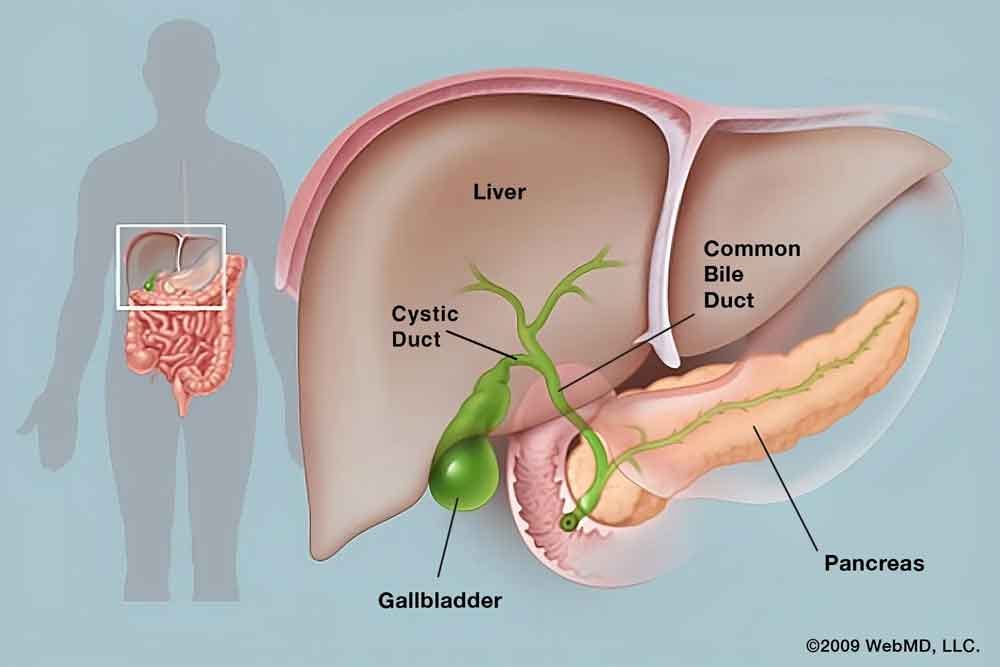
So a gallstone had, having exited my gallbladder, traversed the biliary duct system and ended up in my pancreas. Apparently this is a well-known complication of gallstone attacks, but it had never happened to me before. Since even a small stone can do it, the stone responsible might not have caused any pain when leaving my gallbladder, hence it might not have had anything to do with the two attacks that immediately preceded. But of course, given the temporal proximity, it almost certainly did. As for whether those two attacks were themselves connected, again, given the proximity, they must have been. Maybe a glut of stones found their way out, all at once? Or maybe all three of these events - the two attacks and the pancreatitis - were down to one single stone? That is the most likely explanation, I think. But we will never know; it’s like a silent circus down there.
Friday 17th July
Still in A&E, a black nurse appeared and said she had to inject me with antibiotics, and offered me the choice of “the arm or the belly”. Dreamy with the morphine, I said “oh, whatever you think…” She rolled up my T-shirt. Presumably that location was better, since the drug would reach the pancreas faster. I remember being surprised at the total lack of pain, but of course I was strung out.
Later, I heard two East European doctors talking about me. I looked up. One of them was large and grizzled, in that East European way. He told the other that I shouldn’t be given any more antibiotics, then gestured towards my stomach with his pen, “but those stones need to come out [from the pancreas], and that gallbladder… that needs to come out, if not now then later.”
I was returned to the small room with the chair, where I had first disgusted that consultant by lying on the floor.
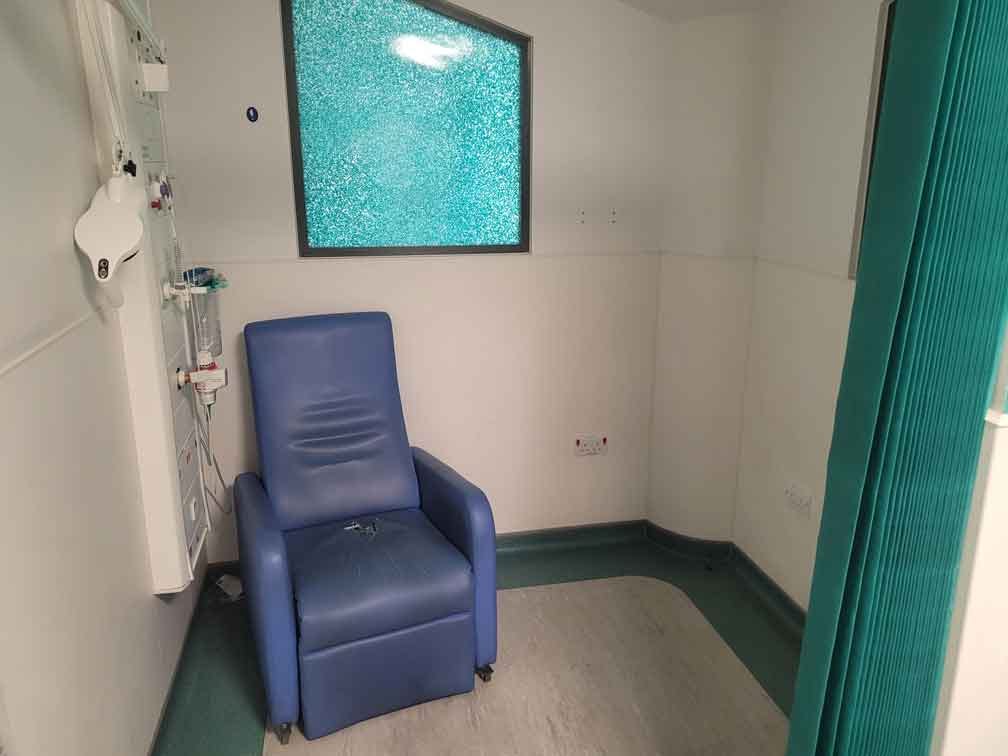
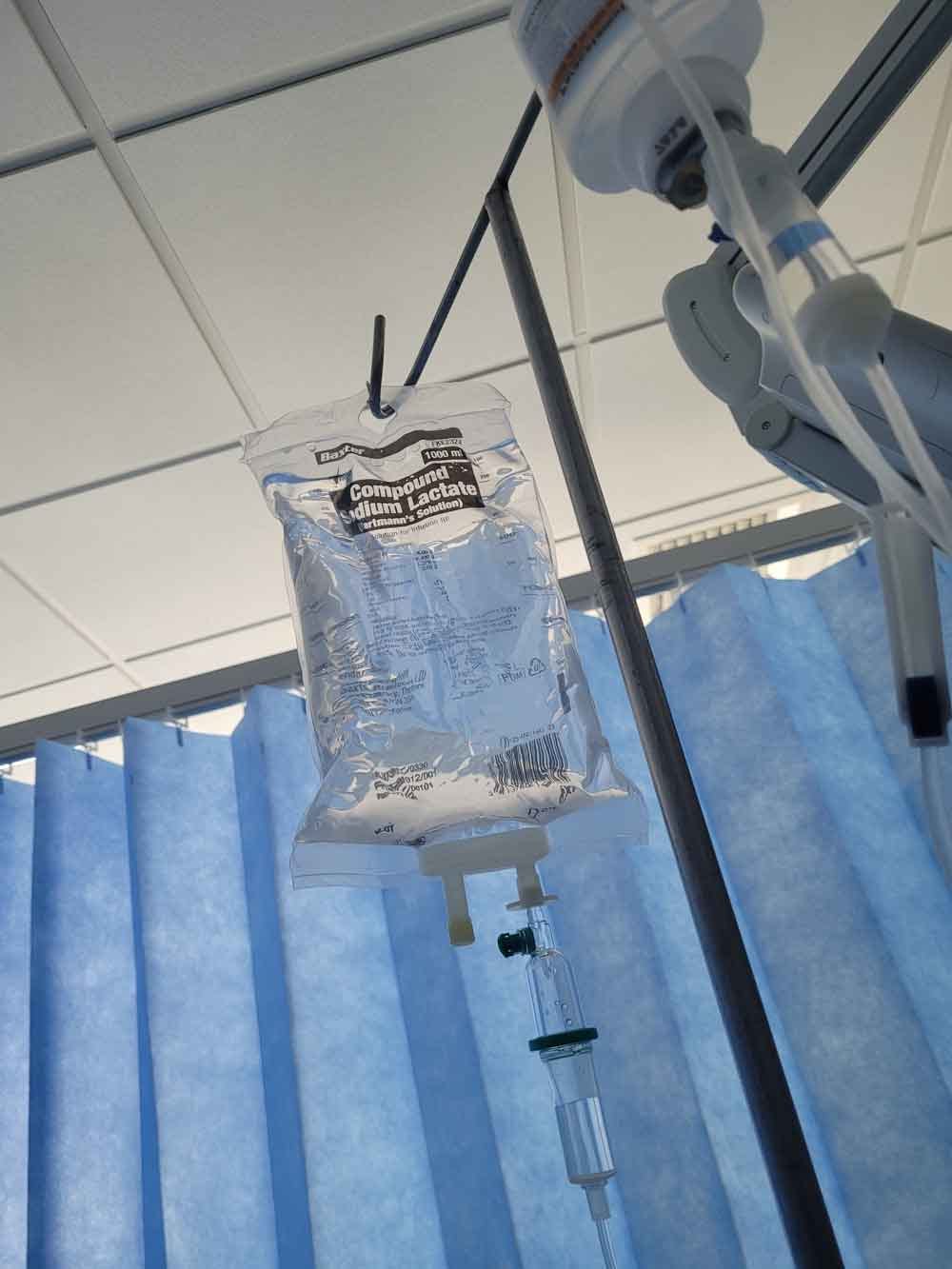
Here the giving of fluids began, immediately. They hooked them up to the cannula from earlier, which was now adapted to take two inputs - paracetamol and Hartmann’s Solution.
They told me I would be here until they found me a bed “in the wards”. I asked if there would be a shower there, and they said yes.
Sleepy, I pulled the curtain shut, got down on the floor again, took off my jacket and trainers and used them as a pillow. It was nice.
After about an hour I woke up and decided I should let “my network” know the situation, otherwise they would start wondering about my absence online. I messaged Martin Lichtmesz and a friend on my Telegram mod team. That was at 3:30pm.
I remembered it was Friday and there wasn’t an essay scheduled for Sunday. I tried to log into Substack from my phone but couldn’t, because in February I had wiped everything from it - including email - in anticipation of an airport interrogation.
Bugger.
I told a nurse I needed another dose of morphine, because the pain was returning. I think this was a bit of a lie, but luckily she believed me and got me a second dose. (According to ChatGPT a dose staggeringly only costs the NHS about 30p, so I don’t feel guilty.)
I fell back asleep.
Twelve hours later I had developed a rapport with a brown A&E porter who had come several times to take my blood pressure and replenish the IV drips. I thought it would be nice to go outside. I ventured the idea to him and he said yes but that I shouldn’t draw attention to myself. Of course. He told me the route to take and disconnected me from the IV drips.
I went, and on the way noticed how lovely it was to be free of pain. The morphine would have worn off by now, so clearly this meant the medical emergency was over.
On the way out of A&E I passed a room with two police officers watching over a guy with blood all over his head. I don’t think the blood was from his injury, but someone else’s.
I passed a vending machine and realised it would be great to have a drink of fizzy water with a hint of raspberry… it was right there… cool and clear… but the a notice said the machine’s card reader was faulty, and I didn’t have any coins on me. Who does, nowadays?
I soon found my way outside. I believe it was where the ambulance had brought me in:
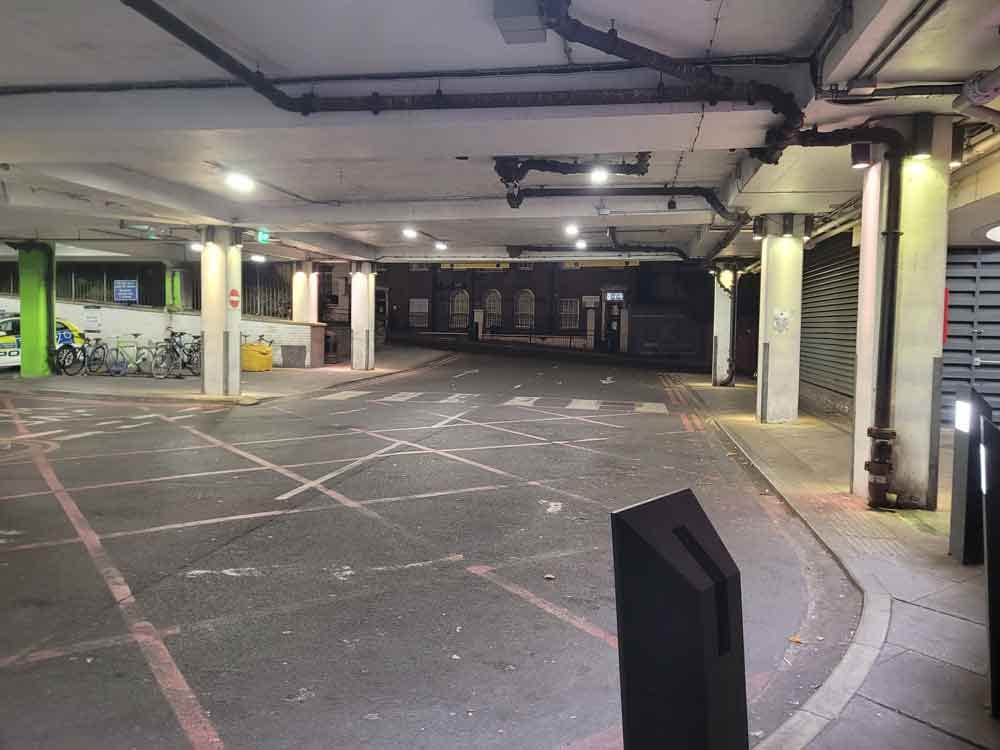
If I had brought my vape this would have been a nice time to use it. Or back in the day, a cigarette. Alas, I had left home in too much of a hurry. So, after savouring the coolness and calm for a few minutes, I just went back indoors.
I ambled back into A&E, through the reception and the throng, back to my small room with a chair. The nice brown porter showed me that the chair could transform into a recliner, so I tried that.
I heard someone clicking a mouse through the wall, now revealing itself to be paper thin. That was baffling.
In the corridor, I heard a middle-aged White man arguing repetitiously with A&E staff, eventually telling them to “ffffffack off”.
Then a mad old Pakistani woman was going on and on and on about various complaints…
By now I’d had a lot of sleep, so I was unable to escape these things. The drama of a London A&E department on a Friday night… To be honest, it was more darkly fascinating than bloody annoying. I now wish I had seen more of it, maybe sat down somewhere for a while and just watched the pandemonium.
Saturday 18th
I remained in that little room until 4pm the next day, by which time I’d been in it for more than 24 hours, mostly on the floor. But now the nice brown porter found me “a proper bed”, so he took me there:
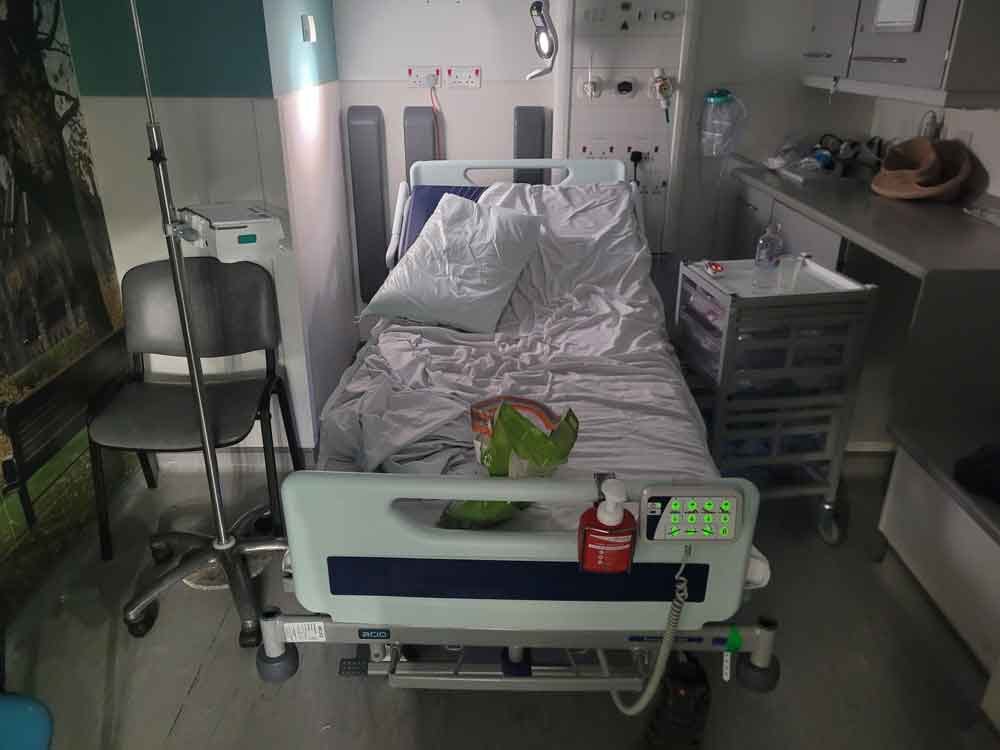
Reconnected to the IV drips, and I was asleep immediately. Very comfy. I had been happy enough in that little room, but it was nice to finally have a bed.
But it didn’t last long. I was awakened just three hours later to the news that they had found a place for me “in the wards”. While they waited for a porter to arrive to take me there, a nurse asked if I would like some toast with butter, and I said yes and she brought it.
There was no space in the hepatopancreaticobiliary (yes, seriously) ward but a bed had become available in the renal ward. A rather burnt-out looking porter wheeled me up there.
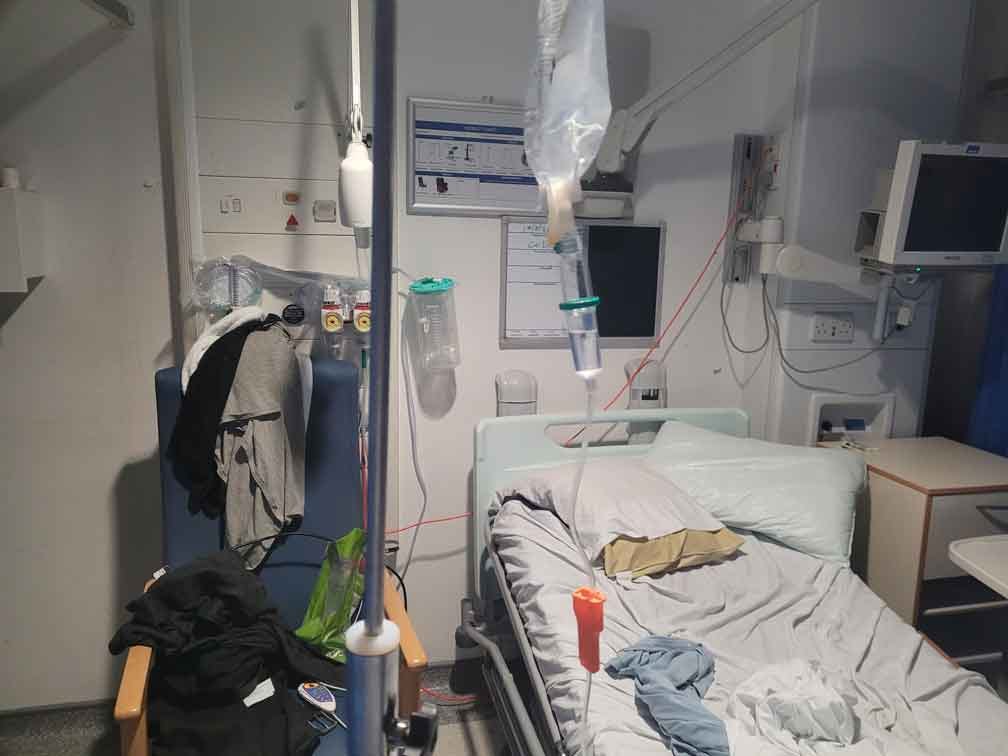
Arriving, I asked about a shower and was shown to the ward’s “bathroom”. The nurse warned me that the shower wasn’t hot. That was true, but it was warm enough. I was relieved to get cleaned up; three days of pain-induced sweat is not pleasant.
And then I settled into ward life. After the rush of those first hours in A&E, the next four days were calm and uneventful.
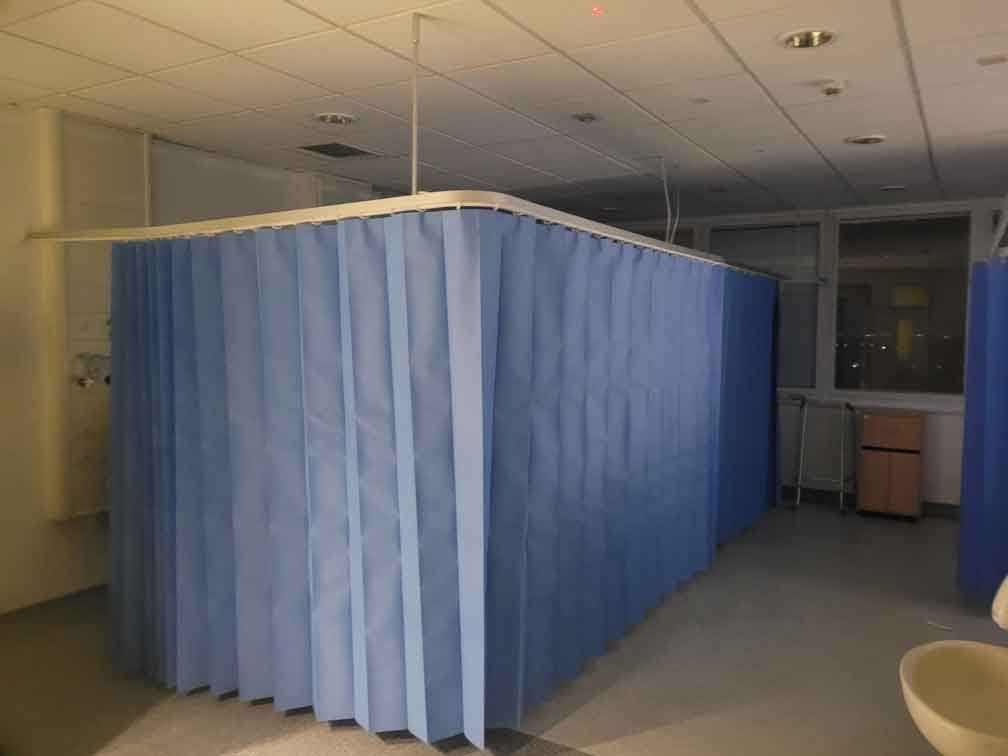
The bed was ideal for me because I was shielded from the sunlight by the adjacent bed (two sets of curtains), and also I was right next to the nurses’ station.
Two hours after I arrived, the other patients were served their dinner. I had arrived too late to order mine. But that was fine, because I wasn’t hungry. Everything was fine.
There were four beds in my room. Opposite me was an old, rather cultured (and I suspect Jewish) man who read the Times every day. He had delirium due to a kidney infection and would quite frequently call out for help he didn’t need, but was otherwise very good-natured. I developed a slight rapport with him, sometimes reassuring him about delusions he was having.
Next to me - through a curtain so I never saw him - was a black guy who constantly made noise of different sorts, including fiddling with his bed’s electronic tilting controls.
Wheeled in shortly after my arrival to the bed diagonally opposite was another black guy, who needed dialysis and I suspect had an IQ of about 80. Occasionally he would get up and wander around, and had a sort of smile all the time but I think was only vaguely cognisant. He could barely speak English so staff struggled to accommodate him. At one point he was visited by two black hospital helpers, one of whom eventually asked him in a thick African accent: “What is your language? Are you from Congo?” Even his fellow Africans couldn’t “connect” with him! Yet he seemed oblivious! What would be a torment for a thinking person was, for him, just another slightly amusing but meaningless fact.
In theory this would be an annoying situation, but in fact I had a lovely time during my stay, drifting in and out of sleep in a very leisurely way. Because I was shielded from the sunlight, night and day simply didn’t matter.
The only problem was the snoring of that black guy next to me. It was unbelievable. As I lay there trying to get some sleep, the ambient offence was so intrusive that my mind began producing abstract visual translations of each tangled, grotesque, evolving snore. Synaesthesia when you’d prefer anaesthesia.
At about midnight, I got up and saw that my phone was at 6% power. I had to do something about it because people on the outside were worried about me so staying in touch was essential. I went to the nurses’ station. There was a black nurse and a black porter. They might have been flirting. I asked if there was any way to charge my phone and the nurse unplugged her own charger and lent it to me.
Sunday 19th
I was awakened at 5:30am by the nurse taking her charger back. She was friendly about it, and by now my phone was fully charged anyway.
Aware that the consultants would soon begin pressuring me to let them remove my gallbladder, I did some googling in cooperation with a friend over Telegram. Removing gallstones from the pancreas (ERCP) is a separate procedure from removing the gallbladder (cholecystectomy). My friend found that the NHS’s official guidance is that a patient should be able to refuse both or either. Though the two procedures are typically done in the same operation, you can elect to have one but not the other. We even found the document which makes this official: NICE CG188.
