


We await the report from the IOPC on the conduct of the police officers who attended the murder of Henry Nowak.
Like many news stories these days in Britain, this one involves multiple institutions, because they all operate together in a concert of dysfunction and insanity. These institutions include academia, the media, the judiciary, the police force, the civil service, the government, the various political parties, the charity sector, the NGOs, etc. But obviously the one most crucially implicated here is the police force. My point in naming these others is to highlight that the police force is not an island. It is part of a general regime which is highly unified, self-reinforcing, adept at rejecting criticism from “outside the tent”, and completely averse to the bitter teachings of reality.
The story of Nowak’s death is causing great public anger. There have been riots and protests, and it might not be over yet. (After all, summer has only just begun.) The issue is DEI and British policing.
What are the regime’s options?
insist that DEI training had nothing to do with Nowak’s death. The cause was incompetence in that particular officer / the lying of the Digwa family
agree that DEI training might have “gone too far”
agree that DEI training has been a disaster
The problem with “gone too far” is that it implies that DEI - ie. “being a good person” - is something one can do too much of. The activist Left will obviously have a huge problem with that idea, but so will the supposedly apolitical institutions we are discussing. If DEI means being good, well, there is no limit to how good one should be. In fact, one should be as good as it is humanly possible for one to be, at all times, in all circumstances, in all ways.
But then examine what DEI entails, in British police literature:
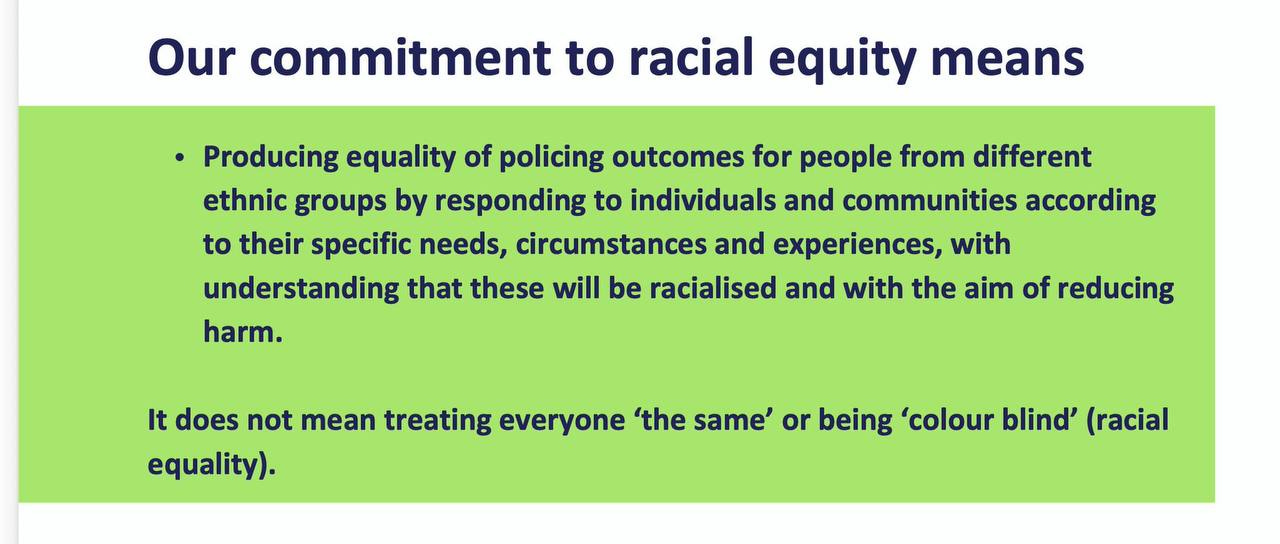
The allegation is that this leads to a two-tier system. The regime vociferously denies that. But, as Morgoth says:


So the question is, can the regime disavow this? That would be for it to disavow, not just one isolated program or policy or training course, but its entire ideology.
However, let’s hypothesise that public pressure became so intense that the British police felt they had to admit defeat and begin rolling back DEI training. I’m not sure they would be able to roll it back.
The Macpherson Report was in February 1999, but I’m confident this goes far before that. At a minimum, we are talking about three decades of implementation. In that time, sensible people have aged out or been pushed out of policing, and been replaced with, at first, pragmatic sociopath types who don’t really have any values but know to “play the game”, but latterly by true believers, people who have never known anything else and can’t imagine that anything else could ever be “okay”, let alone desirable or better. These are women and weak-minded men who went into policing in the first place because their natures matched the mentality of the force. They didn’t have to “adapt” to it; they’d grown up with it and were at one with it already. Indeed, if they were any other way, they wouldn’t have been accepted into the modern police force.
In 2005, a friend of mine who wanted to join the police was told by a seasoned officer that there was no point in applying since, being White and straight, he didn’t stand a chance. Now, the officer was surely exaggerating because I don’t believe that, twenty years on, every single police officer is either non-white or gay. However, in the news at exactly that time was talk of a redoubled effort to get more minorities into policing, which could only mean prioritising those candidates over men like my friend. In the twenty years since, the same talk has periodically been in the news, the unrelenting need to have fewer straight White males and more of everyone else, the apparent self-disgust of a force filled with “so many white people”.
But, while this shows the mentality, it does not demonstrate the problem. After all, all of the police who attended Henry Nowak’s murder were White, so it’s not as if his treatment was due to racial difference between him and the officers. Somehow, White has been set against White. To understand that, we have to understand the principle that unifies the diversity drive with the anti-white mentality of even the remaining White officers.
It doesn’t take much explaining. It is not complicated or subtle. It is childishly stark: “White bad, everyone else good.”
This notion is internalised perhaps especially in White officers, because they have something to prove and because White people, frankly, tend to be more concerned with moral rectitude than anyone else. If the dictum is “White bad”, then they will feel a moral need to demonstrate that, whenever they have a choice, they err against White people - their own kind.
Now, the principle is never actually expressed in the stark terms above. It is couched in a whole thesaurus of academic and sociological jargon as well as countless paragraphs and PowerPoint presentations of cutesy, feelgood, trite, feminine drivel. This is not just so as to “get away with it”; it is because, if the principle were ever stated explicitly, a lot of people would realise “we’re the baddies”. Instead they are invited to arrive at the principle themselves, through their own cogitation and absorption of sundry materials and exercises.
Ideally, they will never be consciously aware of what they have arrived at, for that would enable them to question it. Instead, it will simply be the new condition of their mind, which hasn’t the latitude to reflect on its own condition. The closer a candidate is to that condition naturally, or the more easily they can be moulded towards it, or the more willing to be moulded they demonstrate themselves to be, the more likely they will get accepted into the force. And certainly, the more likely they will get promoted thereafter.
In short: once established, the reigning mentality promotes in its own image, and this become a self-fulfilling and self-refining process that, while needing to be constantly pushed, doesn’t need to be (and mustn’t ever be) explicitly stated.
That paradox of deliberate action without conscious thought is what we struggle to comprehend.
It is also what would make it very difficult to “roll back” the anti-white mentality of an institution. If the staff aren’t even aware that they have a certain belief, how can you persuade them to relinquish it?
But the situation is even worse than that. While they are unaware they hold this belief, they are simultaneously bound to it in a hundred little ways. They are conscious of those ways, and believe each one to be crucial, necessary, decent, “just being a good person”, critical for delivering a just and equitable service, a key aspect of the job, an essential performance indicator, etc. More broad than just professional probity, they will feel that each of these little ways is how they, as police officers, can be moral people and contribute towards building a good society.
So the problem is that they are unaware of the cancer, but believe that a hundred things they do which perpetuate the cancer are essential.
It will be inconceivable to them to work in any other way. For them that would mean not only being unprofessional, but being a bad person.
To see how unconscious this anti-white bias is, compare how the chief of Hampshire Police, Alexis Boon, responded to the death of a violent Black career criminal in 2022 and then to the death of the innocent Henry Nowak in 2026:
I don’t believe for a second that Boon did this consciously, for the simple reason that it looks terrible. He did something that looks terrible because it was completely natural for him to do it. Decades of training brought him to this condition.
The death of Nowak is a matter of fact, not something that moves him. He almost looks uncomfortable voicing sympathy with a White family, as if he is doing something disgusting or low-grade. By contrast, the death of a Black gangster has him gushing, impassioned, deeply sympathetic, and making an effort to imagine the emotions the gangster’s family and community are feeling. It’s over-the-top and affected, but that isn’t the point. His natural reaction - even in footage that will be seen by the general public - is to be gushing, impassioned and over-the-top towards a bereaved Black family, while sympathising with a bereaved White family is a duty he performs with apparent reticence and distaste. Henry Nowak might have been a murder victim, but he was only a White murder victim. Chris Kaba might have been a violent thug, but he was a Black violent thug.
A fish rots from the head. If this is the mentality of the chief of Hampshire Police, imagine the thinking of his subordinates when they arrive at a crime scene involving four Sikhs and one White male.
I acknowledge that his fatal injury wasn’t immediately apparent, and if it had been, doubtless the police would have behaved differently. But because it wasn’t immediately apparent, they just assumed he was lying. After all, the Sikhs were saying so. And because his speech was slurred, they assumed he was drunk. After all, the Sikhs were saying so. He was clearly mildly injured, but they assumed that came from jumping over a fence. After all, the Sikhs were saying so.
As a direct result of these assumptions, which were made so as to dutifully honour the Sikhs’ word over his, they handcuffed him. In so doing, they might have accelerated his death.
Moreover, we have to bear in mind that there were two 999 calls regarding this incident. One characterised it as a stabbing, the other as a White-on-Brown racist assault. It is unknown which of these calls was made first, but it is clear that the police enroute to the scene were informed of only one of the calls. The racism claim was prioritised over the stabbing claim even before police got to the scene. This biased them in how they would interpret what they saw once they got there.
So the problem is not just with the front-line officers but with the dispatchers who inform them. But we can see that it is also with the chief who manages them, and of course all of the tiers of command in the middle.
We can only hope that it doesn’t also infect the IOPC that is now investigating their conduct. But if the IOPC should find against the officers, it will have a choice as to whether to blame incompetence or DEI training. If it asserts that DEI training is causing critical operating problems in policing, that means it will have to be modified or outright abolished.
But then we get to the problem I described earlier. Even modifying DEI would be anathema, would seem like heresy, like evil, to the people who now staff the British police force. And they in turn have to answer to the rest of the regime - the media, academia, the government, the civil service…
In a time of universal deceit, can one institution break away and tell the truth?
I remember seeing an interview 20 or so years ago by a senior police officer from London who was retiring and he said he knew the rot had set in when a new senior officer changed the standard procedure they had of putting pictures of offenders that they were to look out for that day on the wall. The new senior officer was offended to see virtually every one of the pictures was either black or brown as this was "racist" when in fact it was for the simple reason these were the people who were committing the crimes.
The only way to ensure these people were no longer to be regarded as criminals was to hold them to lower standards and so down the spiral began. I don't think even that new senior police officer 20 years ago would ever have thought that his stupidity would result in police officers having a nice chat with a murderer and his accomplices as their white victim lay drowning in his own blood cuffed at their feet but that is where the DEI criminality of different standards always leads.
As lucid, clear-eyed and harrowing as it is maddening. Great stuff Woes. You and Morgoth have each knocked the coverage of this disgusting affair out of the park. It's tempting to become histrionic or combative at the scale and depth of both the injustice and the unthinking ideological capture on display here. Not to mention the subsequent regime response to Henry's senseless murder. The combined private managerial and elite media classes didn't even show this kind of brazen narrativizing and denial of reality after Southport and the Manchester Arena killings. This particular atrocity, having come after the combined powder keg of the others, is different. The visibility and the revulsion. It puts into sharp, immediate relief how dire the cultural eschaton is over here in the UK. These incidents - killings of whites through unchecked immigration and cultural disunity, special religious dispensations for minorities and targeted two-tier policing in favour of non-whites - will only pile up. As will the response. That response, given it's existential bent and the disbelief, hurt and betrayal at its heart, will of course lead to an even more malfunctioning social fabric among different peoples. This is observable reality, only argued against by the same utopian fantasist blank slatists who have knitted and torn our frayed cultural quilt in the first place.
Look at the BBC, the Guardian, Shabana Mahmood, Keir Starmer, David Lammy, Owen Jones - the wagon circling is insane. The call to not politicize this murder and the widespread institutional failures on either side of it - hiding behind the words of a grieving and state-coached father attempting to understandably turn the temperature down - is laughable enough; as is the comparison between these same politicians and media figure's reaction to George Floyd and the BLM riots vs Henry Nowak. But the paradoxical white guilt and white savour complex, classism, and luxury belief globalist NPC-speak of LBC's James O'Brien takes the cake. It's very hard to maintain composure when watching this utterly detestable unthinking cultist. He's a loathsome, cruel, genuinely stupid stooge for progressive thought-terminating clichés. He's a gross gammon stereotype in every single negative sense barring his complete inability to identify the remotest problem with liberalism.
Dreadfully sorry for the length of this mate. Your work has always been extremely cathartic to read, but has been doubly so recently. Take care, keep it up and be safe.