


I have always found vigilante films hilarious. The anomaly is Taxi Driver, which manages to be thoughtful and original. Every other vigilante film I have seen (and I have seen many) is trash.
They are very formulaic: an ordinary guy who abides by the law, pays his taxes and believes in the system, suddenly finds himself betrayed by it, and decides to get revenge and right a societal and moral wrong. Thus, built into the formula are both personal retribution (selfish, satisfying) and abstract justice (altruistic, duty). This is why, as predictable and silly as these films are, they are often highly enjoyable.
The genre is inherently masculine. We see a guy on a mission, working on his own, using tools, solving problems, improvising, bucking the system, striking out, acting in secret, and asserting himself brutally… but in the name of good. Implicit in the formula is the idea that social systems might be inadequate and it might be necessary to break the rules, to literally take the law into one’s own hands. Men find that exciting, women find it very troubling. Tellingly, so do liberals.
The genre is almost custom-designed for exploitation, and indeed every vigilante film turns out to be exactly that: trashy titillation of the audience’s base lust for revenge and a knee-jerk conception of “justice” which callously brushes aside all the post-war dictums about crime being an understandable result of social inequity, deprivation, marginalisation, etc. Women find that upsetting. Tellingly, so do liberals.
It’s no surprise that the genre has always met with lofty disapproval from liberal critics. They despair of the public’s base appetites, and wish film-makers had enough integrity not to make such obvious, reactionary, crowd-pandering slop.
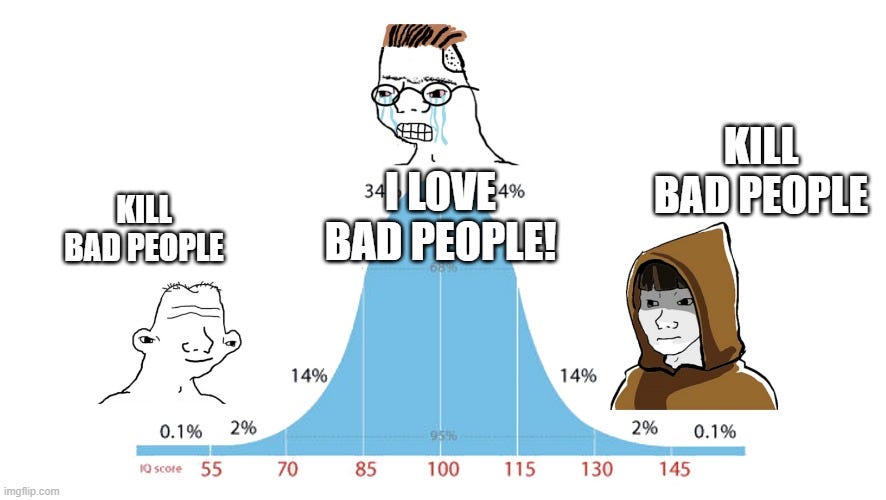
The genre is inherently poised against liberals. It takes as a given that the civilised West is too weak on crime, that bad people do bad because they are bad and therefore the only solution is to meet violent wrong with violent right. When evil outwits lawful good, chaotic good must be allowed to intercede. For the liberal, this is a quadruple-whammy:
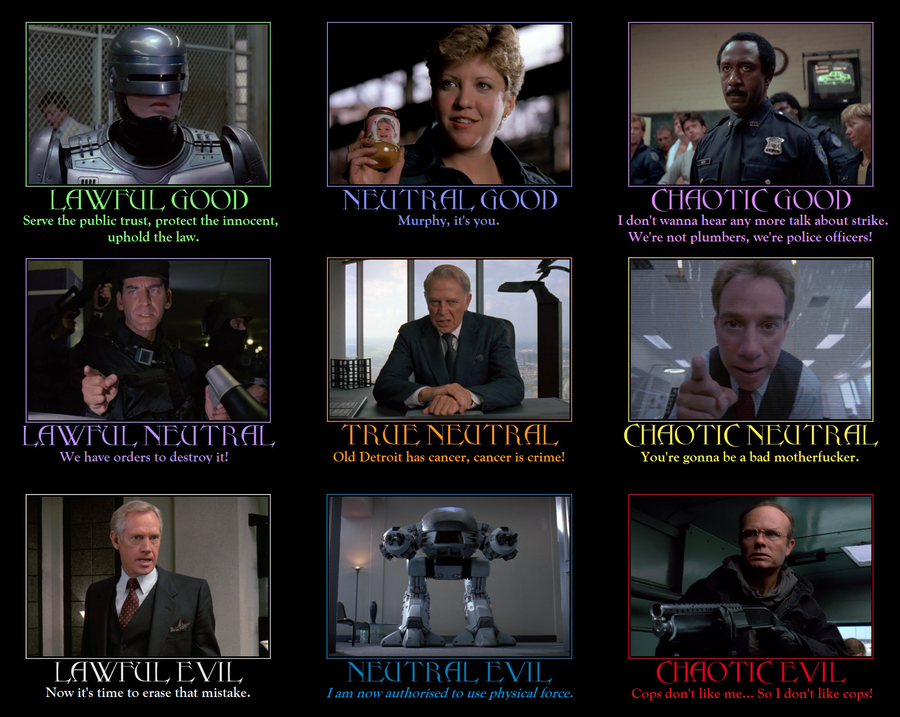
we should be “cruel” to criminals (disadvantaged, misunderstood)
people are not blank slates, and can be born evil
our liberal system is unfit for purpose
there are times when no organised social system can suffice. This throws into doubt the very possibility that we can ever fully transcend primitive animal existence.
Worst of all for the liberal is that he feels the same rush of joy that we all feel when the vigilante “takes out the trash”, putting a bullet through the brains of the beast who raped an innocent young woman. That bastard thought he’d got away with it, tricked the system, fooled that judge, and perhaps on his way out of the courthouse even mocked his victim… well, now he has paid the ultimate price for being a piece of shit. How can anyone resist feeling pleasure about that? The liberal can’t.
And so the vigilante genre shows the liberal that he is an animal, after all. Despite his pretensions and all those books he read about intersectional wiffle-waffle, deep down he is just like the reactionary right-wingers he despises.
Moreover, while it is true that vigilante films satiate a primitive instinct in the viewer, it seems likely that people will be most amenable to such satiation when their society really is too soft on crime. The spate of vigilante films in the 1970s, headed by Death Wish, were responding to a widespread feeling in America at the time that the courts were too often betraying the public by releasing violent scum back onto the streets. Whether it was a bloated bureaucracy, a lily-livered judge, a corrupt district attorney, the “expert” testimony of a Marxist professor, or the pleadings of a milksop female social worker, the system had become ineffectual, and the result was the dystopian squalor of inner city New York, Detroit, Chicago…
Though the vigilante genre fell out of fashion, it never went away. In fact there has been a steady stream of vigilante movies ever since 1965. As Hollywood declines and relies more and more on formula, there is one formula that is always reliable.
But the genre has never evolved. For fifty years it has ruminated on the same social ills. What is notable about the film we will discuss is that it drags the genre kicking and screaming from the 1970s to the 2020s.
The average liberal instinctively bristles at the tropes of classical vigilante cinema - “soft judges”, “nanny state”, “timid policing”, “moral decline”, “criminal parasites living off hard-working decent ordinary people” - but they long ago came to accept the genre as a necessary sop to right-wing idiots. I think the attitude was: “Let them have their trashy bread and circuses, if it keeps them docile while we remake their world around them.” After all, the tropes referred to realities that were incidental, not fundamental.
But today there are new realities, which today’s liberal cannot stand to see acknowledged because this strikes at the core of his worldview. These realities are fundamental, not incidental.
The first reality is that diversity has, far from improving White societies, degraded them in every way - economically, morally, culturally, socially, legally, educationally, physically, visually, aurally, olfactorily, and even medically.
The second reality is that the above degradation, far from a temporary side-effect of diversity, is inherent to it, unavoidable.
The third reality is that this permanent link between diversity and degradation is clearly known by the powers-that-be. Worse still, given that they continually advocate more diversity, they must actively desire the degradation that it brings.
The liberal cannot stand the idea that elite advocates of diversity advocate it, not because they agree with the liberal that diversity is good, but because they know that diversity is bad. This would mean that the liberal is a fool and has been played, and furthermore, that the elite do not love the liberal and see him as their equal, but despise him and see him as their useful idiot. This means he is not the thinking, discerning sophisticate he has always believed himself to be, but a gormless dupe who “thinks” whatever he has been told. (Which he is.)
Obvious lies can be tolerated easily, even happily, because they are obviously lies. Truths, even subtle ones, are painful.
And loud truths, truths spoken crudely and rudely, without any sense of decorum or nuance or good taste, truths that crash into your day like a fascist T-Rex, are unbearable.

Citizen Vigilante is a contemporary vigilante film written, produced and directed by the German am-auteur Uwe Boll. Aged 61, Boll has a long history of making films that are panned by critics and audiences alike.
Hollywood actor Armie Hammer had been “cancelled” in 2021 and was looking for a come-back vehicle. Boll persuaded him to play the lead in his new low-budget flick. What it will do for Hammer’s career is as yet unknown.
Objectively, Citizen Vigilante is a bad film. The production is competent enough. The real shortcomings stem from the script.
Sometimes I burst out laughing. Some scenes I couldn’t stop laughing throughout. It is bad, but it is enjoyable.
There isn’t really a storyline. What linear events occur are needlessly (perhaps to disguise the lack of a storyline) presented in a random order. One would say the film is more a character study, if it did any character studying. It is perhaps best described as simply a sketch of a situation.
American soldier Michael Sanders is visiting his ancestral country, an unnamed one in Europe. Apparently, he came to attend his father’s funeral and assume the running of his business empire, expecting it to be a fairly short visit, but ended up sticking around once he realised there was a need for brutal vigilante justice in the city, in the country, in the continent.
We don’t see any of that. The factors and process that led to his vigilantism are not important to Boll, who assumes that the audience already “get” the situation in Europe. His intent is to show that something can be done about it.

A narrative device throughout the film is a newsreader (with an oddly archaic English accent) giving updates on the situation. Except, she doesn’t really give updates. Most of the time, she just says what Boll clearly wants the audience to think. She speaks in a calm and precise way while being shamelessly partisan, couching rhetorical “questions” in an absurdly thin veneer of impartiality.
As well as the brazen one-sidedness, another thing we quickly notice about Citizen Vigilante is the generic-ness. This might be incompetence on Boll’s part or it might be deliberate, because the story is applicable all across Europe.

The filming location was Zagreb but absolutely nothing of Croatian culture is shown. Instead, we see a nondescript “modern European city” in which the architecture could be anywhere, the only culture is globalist consumerism, and all the people speak in American English with placeless “Eurotrash” accents. This extends even to lead actor Costas Mandylor, who is Australian but here adopts an amalgam of European accents (perhaps fittingly given that his character works for Interpol).
Depicting a generic “European city” feels lazy and offensive, but then I remember all those Hollywood films I grew up with, set in generic “American City”. Often they were not even shot in America - Toronto or Vancouver serving as generic stand-ins for a different country!
But we take it for granted that European countries are more distinctive, with deeper histories and more pronounced cultures, than the New World. Therefore it is depressing to see “Europe” presented as a blended puree, retarded by American entertainment, filleted by the 20th Century, de-souled by global capital, and now raped by kaleidoscopic immigration from every corner of the Third World, destroying the uniqueness of each European country. But this is exactly what has happened. Like other aspects of the film, what Boll did with the setting might be audacious or accidental, but is accurate.
Sanders does not quite fit the classical vigilante mould, an everyman victimised by the corrupt system. He is more like Bruce Wayne, being the orphan heir to a fortune and thus having plenty of time and resources to expend on “healing society’s sickness”. (Actually, back in 2007 Armie Hammer was cast as Bruce Wayne, for a film that was never made.) What he does have in common with the classical vigilante is military experience, having served in the US army. He is thus a highly-disciplined expert in weapons and killing. Convenient? No more so than his apparently limitless wealth.
Also convenient for the plot is his limitless resourcefulness. He can obtain heroin, a clean syringe, infinite guns and ammunition, the personal phone number for an Interpol officer, a shed-sized bulletproof iron safe, and cars that won’t be traced back to him.
But more convenient still is his limitless immunity from police detection. Sanders has no fear whatsoever of CCTV evidence, fingerprint evidence, DNA evidence, or witnesses. Where the classical vigilante must operate incognito, and Bruce Wayne must invent a complete alternative persona, Sanders simply marches in, kills the bad guys while delivering some political commentary, and marches out. He even does this in broad daylight, so unafraid is he of being seen, detected, filmed, tracked, recognised or accosted. At times it was like watching the T-800 mechanically going about its mission, until I remembered that, with its artificial skin, the T-800 actually does wear a disguise.
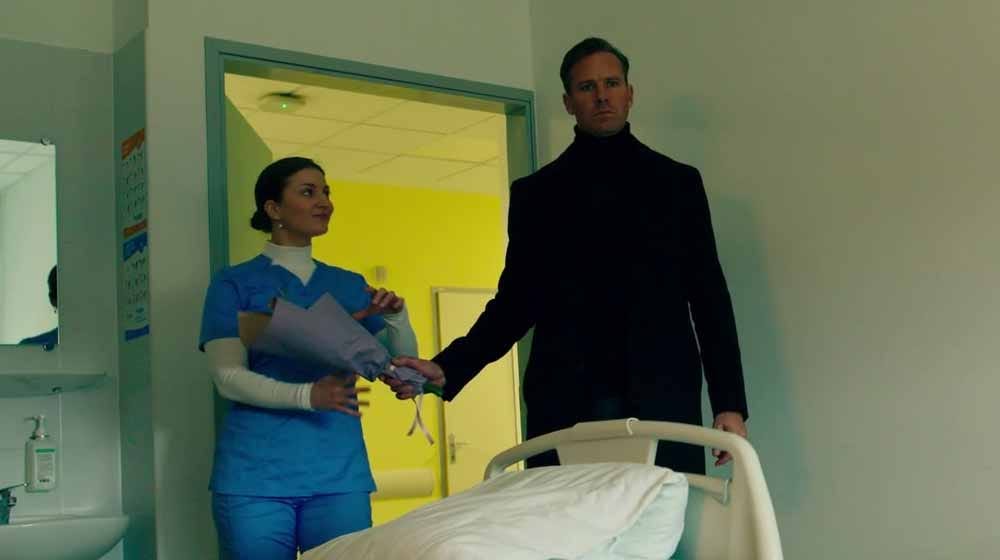
Sanders is constantly serious, unfriendly and humourless. In virtually every shot he has a hilarious expression, something between steely rage and steely disgust. He can be walking on a sunny day yet looking as if someone just keyed his car. Only once and very briefly in the entire film does he smile. He does it for no apparent reason while on a bus:

On one occasion, when a barmaid has to go away for a moment, he dreamily says “I’ll watch the bar”. His voice, in this single moment, has a note of irony. This might have been an oversight by the director, because every other line of dialogue is delivered by Hammer in robotic monotone. (I was impressed, actually, by his ability to memorise long screeds of political and social commentary.)
For the first half of the film Sanders is an enigma, with almost no character sketching whatsoever. The only thing we are shown is that he is bothered by dilapidation: he photographs the decay on one of his buildings, and is angered by human apathy causing wall plaster to rot. Presumably this reflects his irritation with the decline of society being allowed to progress.
We get some insights during the film’s sex scene (which is gratuitous as the information could have been conveyed without sex): Sanders owns lots of property, has a Hebrew tattoo, is not racist (the prostitute is non-white), and is “morally ambiguous” enough to frequent prostitutes. I applaud Boll for finding a way to sketch the character of Sanders that isn’t overt dialogue, but unfortunately, the revelations are all rather pointless since none is ever developed. Like the sex scene itself, they have no bearing on the story.
Then, 48 minutes in, we get two scenes that inform us about his background. He talks about his estrangement from his parents, which he has “come to terms with” meaning that he is not angry or resentful towards the father who neglected him. There might be a question mark over whether Sanders is being honest with himself about that, but if so, Boll never explores it.
Sanders’ moral ambiguity is developed slightly. He is needlessly rude to his employees (“Smells like a nursing home in here. Let’s get some fresh blood”). He uses mafia-style intimidation tactics to force rent out of tardy tenants. Finally, to pointlessly demonstrate an obvious truth to a man who is too drugged up to understand it anyway, he pointlessly causes the death of a passing motorist.
The trouble with this “moral ambiguity” is that Boll doesn’t do anything with it. We don’t see Sanders struggling with it, tormented by his dual desires to be good and to be horrible. He seems completely content being a man who is needlessly rude and even needlessly murderous but who also puts himself at huge risk for a moral cause. Good writing would have explored a conflict; Boll’s bad writing merely presents a contradiction.
Boll seems to have intended Sanders to have some depth, but didn’t know how to go about it. He never has any doubts, never changes his mind, never has a learning experience, never makes any mistakes.
But then again… would you really want him to? That brings us to the question of what this film is for, what this film is. And, whatever delusions Boll might have about his abilities as a film-maker, I think he knew what he intended this film to be, and I think he succeeded.

Sanders is a one-note character because that is what ordinary Europeans, tormented by mass immigration, want to see: a man just getting the job done. Citizen Vigilante is a film aimed squarely at those people. Boll has no interest in “showing both sides of the issue”. He knows, as we do, that the other side of the issue has been broadcast ad nauseum, for decades. We know the claims, we know the counter-claims, and we know the situation is intractable and that liberals are beyond persuading. There is a need only to take action against them and the dystopia they have built.
Billionaires Elon Musk and Duncan Bannatyne have endorsed Citizen Vigilante.
Liberals, of course, are apoplectic, about that endorsement and about the film itself. Their first go-to was to pretend to believe it is an elaborate joke, that Boll is merely trolling. He immediately clarified that he is not trolling; the film is meant seriously and straightforwardly.
Captured (like all institutions) review website Rotten Tomatoes did its usual thing, its “professional” critics vastly out of step with its public reviewers.
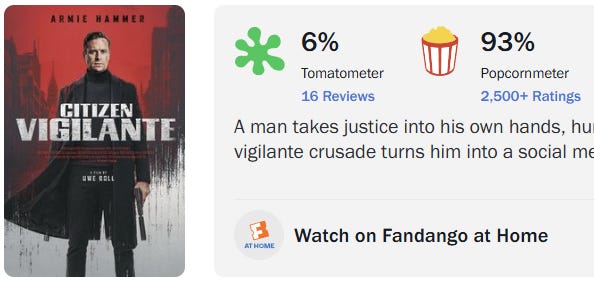
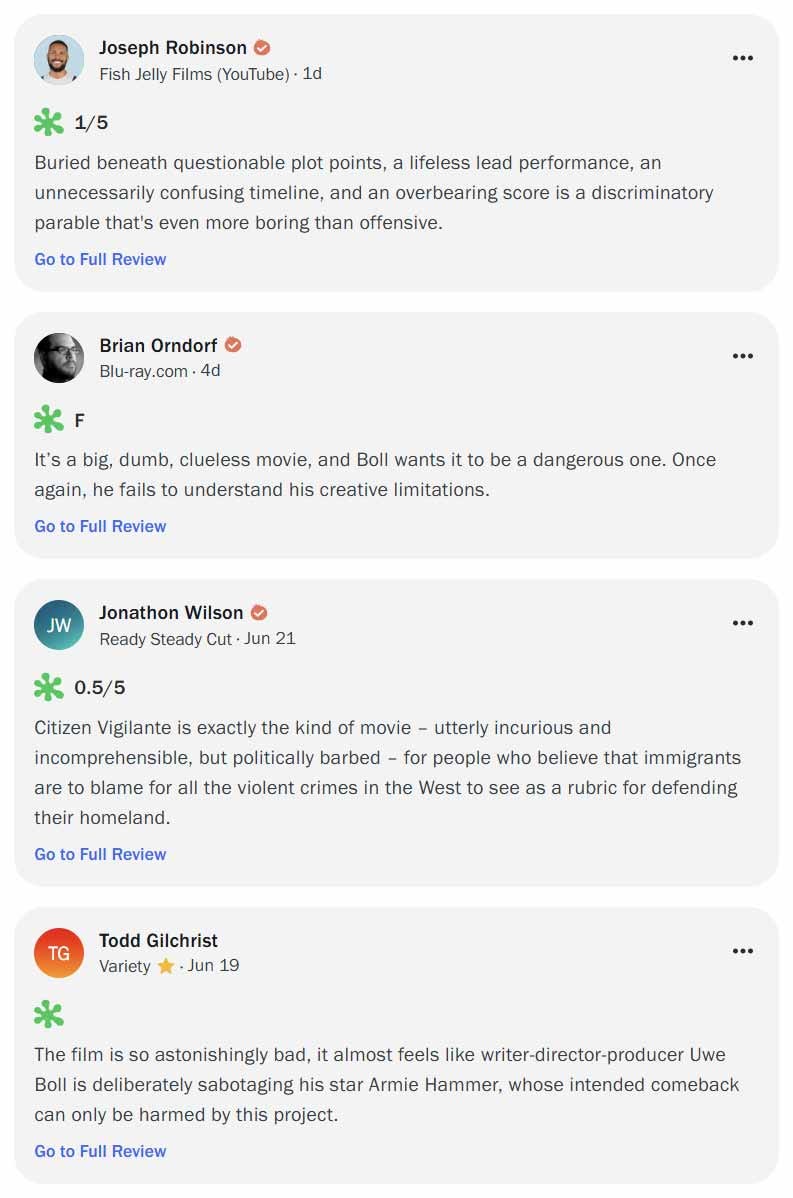
In theory the professionals are correct: this is a bad film. But in reality that doesn’t matter, both because the film shows the real situation in Europe and the real feelings of Europeans, and because the Left has lost the right to condemn anything on artistic grounds, having long ago degraded all of their art into crass propaganda.
But of course, when the Right do the same, that’s terrible. For the Left, it is always outrageous to see the Right having an opinion, and especially having a platform on which to voice it. They assume that, being right-wing, our perspective is inherently invalid, since validity comes as a quality of left-wing-ness, and therefore it is both unnecessary and unwise to allow us to speak.
After decades of that oppression in the media, academia and online, the Right have begun to seize the means of culture production, without giving any lip-service to impartiality. The result is a million memes that voice our worldview, cartoons like Murdoch Murdoch and The Will Stancil Show, online festivals like Millenniyule and Decameron, and films like Citizen Vigilante. These works come unapologetically from a right-wing perspective.
In the meantime, the same “hardening” has occurred on the Left, though for the opposite reason. The Right hardened because we were excluded from the institutions; the Left hardened because they had total control of the institutions.
The result is a film like One Battle After Another, a shameless leftist screed, completely one-sided, doctrinaire and supportive of leftist violence and terrorism. Other organs on the Left, having in their decadence lost all self-awareness, praised and celebrated the film. It was awarded no fewer than six Oscars, among a slew of accolades so extensive that there is a dedicated Wikipedia page.
With leftist propaganda as shrill as One Battle After Another, nobody should be surprised that the Right give up on “being reasonable” and “meeting them in the middle”, and simply produce a film like Citizen Vigilante.
So, is this how entertainment will be now? The Left and Right in a race to the bottom, competing to make the most crude, prejudice-affirming propaganda? Perhaps. But if so, our films will be the truthful ones, and this war of attrition will result in a Left exposing itself as utterly morally and intellectually bankrupt. Stripped to the bare bones, deprived of artistry and budget, our version of the world rings true, while theirs, bloated with expertise and prestige, discards all subtlety and reveals itself as insane, dishonest and suicidal.
Uwe Boll is clearly not a deep thinker. In an interview with Jared Taylor, he comes across as very much “an ordinary bloke”. This is why he is not an artist; he lacks the thoughtfulness and sensitivity that lead to art. But it is also why he would make something as crude as Citizen Vigilante, which can function as a battering ram and a rallying call, reducing the Left to “I can’t even” spluttering while emboldening more thoughtful right-wingers to make films that are better than it.
The danger is always the “limited hangout”, the release valve that seems to sympathise but actually misdirects. People have pointed out that Citizen Vigilante is distributed by a Jewish company, its lead actor is of Jewish descent (although he is only 1/8th Jewish!), its protagonist is apparently somewhat Jewish, and its narrative is more anti-Islam than pro-White.
The last is the most interesting for me. For all the fuss the Left have made about this film, it really isn’t racist. It repeatedly states that the problem is not race but integration, that what is at stake is not genetics but values. In the climactic scene, Sanders chides a Muslim family not for their religion or ethnicity but for their “commitment to religion over democracy and over anything else, including the rule of law”.
It is not even anti-Islam per se. Sanders condemns “archaic values” but also says that among Islamic populations there are “good ones” as well as “bad ones”.
As for a traditional White society, the film never yearns for that. No comment is made on the awful modern architecture or the dead culture. Everyone speaks English and consumes products, and it’s fine.
So what this film advocates is kosher, race-blind, civic globalism.
Boll doesn’t care about race. He just wants them to integrate. If they do, Sanders won’t blow their brains out.
The trouble - for Boll, for Sanders, and for civic nationalists everywhere - is that these people, en masse, cannot integrate.
And everyone who celebrates the film knows that. Even the film itself seems to know that, implicitly; if you are at the point of summarily executing entire families, that would seem to be well beyond any hope of their co-ethnics integrating. Killing the bad ones isn’t meant to “encourage the others” - it’s meant to scare them shitless so that they self-deport.
Thus, the lingering message is not “if we kill enough of the bad ones, we can make diversity work”. The message is: “diversity doesn’t work”.
As a result, I am not worried about the Jewish involvement in this film. I think their intentions rather fall by the wayside in the face of what the film achieves. It gives voice to a disenfranchised majority. Will the Left take heed, and begin making balanced films or even right-wing films? Of course not! But that isn’t the goal. The goal is to legitimate and articulate the nativist viewpoint. The Left cannot win here: admitting error is not an option for them, but the more they refuse to admit error, the more they show themselves to be irredeemable.
So in summary… is Citizen Vigilante a good film? No, but I am glad it exists.
We should think of Uwe Boll as a cinematic vigilante. He broke the rules and did a bad thing, a terrible thing, but he did it in the name of good.
Great paragraph:
"The liberal cannot stand the idea that elite advocates of diversity advocate it, not because they agree with the liberal that diversity is good, but because they know that diversity is bad. This would mean that the liberal is a fool and has been played, and furthermore, that the elite do not love the liberal and see him as their equal, but despise him and see him as their useful idiot. This means that he is not the thinking, discerning sophisticate he has always believed himself to be, but a gormless dupe who “thinks” whatever he has been told. (Which he is.)"
Great analysis. I found the film enjoyable and puzzling. Sanders is an enigma but I think (from several clues which must be intentional) he's a Kafkaesque figure, not so much allegorical as haloed by symbols, given a mythic depth which never quite resolves into straightforward allegory, but gives you an unsettling sense that something else is going on, in this case it is very Kafkaesque, Biblical. Probably wouldn't have worked with a lesser actor, luckily Hammer is allegedly a cannibal rapist or did something to piss off Hollywood, so Boll got a first-rate 6 foot 5 inches presence; who knows, the cannibal rapist aura might even help here, that sense of brooding violence beyond ordinary limits.
Would love a sequel where the media are more realistic and Sanders expands his remit from migrants to journalists. That would be HIGHLY satisfying.