

(Note: I learned recently that Tony Harrison died last year. I want to emphasise that, whatever criticisms I make of his work and worldview, his talent was unique and I am sure his intentions were good. RIP.)
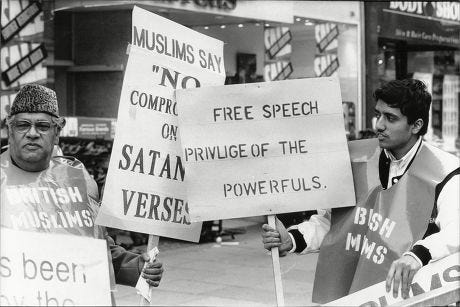
The Satanic Verses furore erupted in September 1988 as soon as Penguin Books published the novel by Salman Rushdie. After five months the uproar was only getting worse, yet Rushdie remained sanguine. Having been adopted into the Western liberal elite, he had absorbed their self-confidence. Ordinary Muslims in Britain perceived him as a traitor to his religion and to his beleaguered kinfolk; he had joined “the powerfuls” and now, like those kuffar decadents, was drunk on “privlige”.
Unabashed by all the offence he had caused, Rushdie wrote a letter to the Guardian advocating the scrapping of blasphemy laws (to make books like his less legally risky to publish) and mocking his opponents Hesham El Essawy and Max Madden:
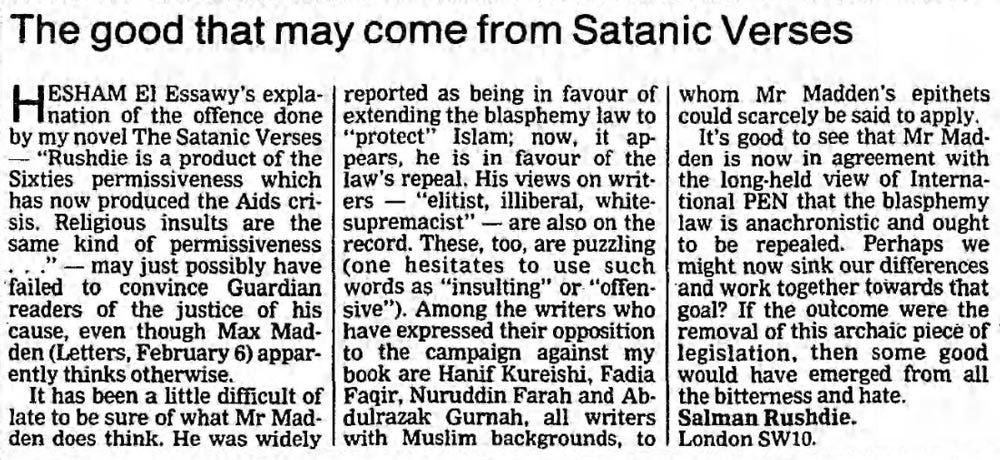
Note the smug tone. It didn’t last long. Eight days later, Rushdie’s life changed forever when Ayatollah Khomeini issued a fatwa for his death. Rushdie would spend the next decade in hiding and the rest of his life venturing out in public only with bodyguards. By 2022 he had relaxed a little too much and was maimed.
The fatwa was announced on the 14th of February 1989. Tony Harrison quickly wrote a poem in response, publishing it in the Observer on the 19th.
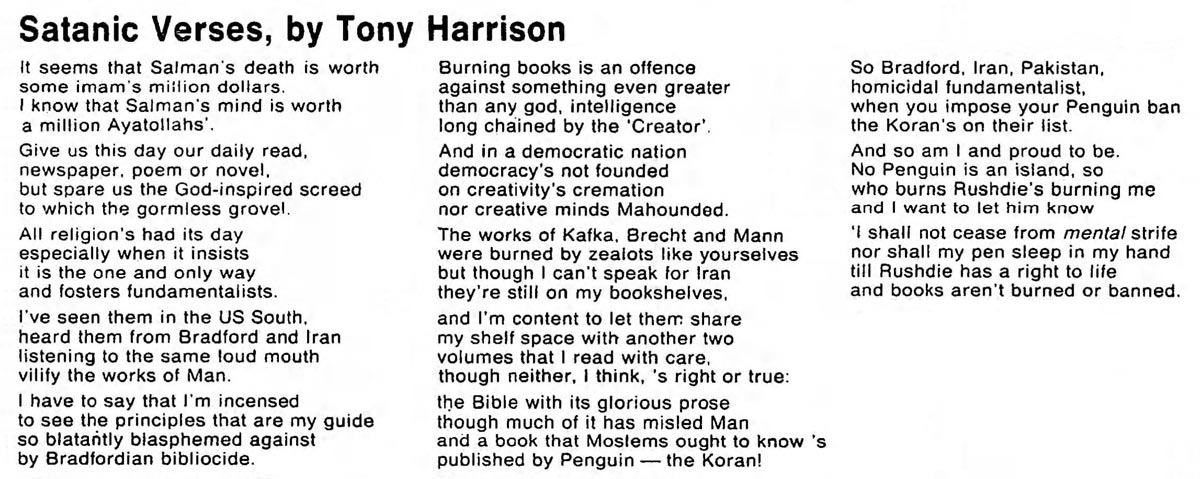
As far as I know this poem was not widely celebrated and Harrison did not include it in any subsequent collections. However, it is valuable in illuminating various things about the thinking of its era. In particular, looking at it from 2026, we can see wishful thinking and naivety undergirding the entire text. The ultimate products of the liberal worldview are not insight, reason and enlightenment but, yes, wishful thinking and naivety (which, untempered, will lead to oblivion) as well as cowardice and intellectual impotence. Liberalism is like an acid, dissolving everything that you might draw strength from and leaving you determined to exact the same fate on other people via undermining whatever gives them strength (eg. their religion, their traditions, their nation, their ethnic group, or even the project of civilisation).
I will comment on various parts of the poem.
spare us the God-inspired screed
to which the gormless grovel.
Admittedly, it is “low-hanging fruit” to attack this bit, but that only raises the question of why a man of Harrison’s intellect wrote it. Time and again, liberals say things they must know, or could easily know, to be fatuous or outright false.
Overlooking the arrogant dismissal of (apparently) all religious thought, I have to point out that the public are gormless with or without religion. Almost every contemporary thought-plex - from covid to equality to feminism to MAGA - beguiles the public only because they are gormless.
But Harrison seems to understand this; he says that the gormless grovel to religion, not that religion makes them gormless. If this is true, what does he suggest be done with the innumerable gormless? Should we just look down on them, in perpetuity, for being what they are, and assume that they pose no threat to us more discerning chaps, and that no demagogue will use them to destroy us? If we recognise that the masses are malleable, it would seem not only a moral duty but also a matter of self-preservation for us to mould them, not to leave their moulding to the winds of fate and whatever their undiscerning minds are drawn to. Harrison doesn’t seem to have thought of this. But he believes in the elevating powers of learning and civilisation - the things that pulled him out of the working-class - and no doubt believes they will do the same for Islamist fanatics. (Even on that detail, he is wrong; a number of Islamist terrorists have been highly educated, including trained doctors.)
However, I think we have to assume that Harrison believes the masses would be less gormless, but for religion. In this way he has a very optimistic view of humankind - very typical of his generation, but, yet again, grossly naive.
So much for the masses, but I would also say that even sophisticated men like Tony Harrison can be gormless. For example, he believes that all people can be rational and can thrive without religion, even though this has never happened before in human history. He believes it because he wants to believe it. How is this thinking more rigorous than that of any religious fanatic? The latter believes what he is told, while Harrison believes what he wants; both are slaves to irrationality. But only one of them is prepared to slaughter in defence of his beliefs. It’s like leaving a poodle in a room with a Rottweiler.
All religion’s had its day
especially when it insists
it is the one and only way
and fosters fundamentalists.
As we have seen with the rise of “wokery”, the masses are attracted to any creed which gives them certainty, or a sense of certainty, especially if it also authorises them to feel good about themselves and superior to others. Some of them will merely take solace in the creed, others will become fundamentalist promulgators. The fanaticism with which people today believe in “equality”, and the violence that antifa mete out to their opponents without a moment’s self-doubt, prove that the creed needn’t be a religious one in order to inspire fundamentalism. In the absence of religion, other creeds will innocently emerge or be maliciously manufactured to fill the void, which is very real. “The God-shaped hole” is a problem that simply cannot be denied, and it is irresponsible of intellectuals and social commentators to do so. But I cut Harrison some slack on this; it was 1989, not 2026.
democracy’s not founded
on creativity’s cremation
He is referring, literally, to the burning of books, but figuratively to the broader activity of destroying ideas.
His sentiment is a well-meaning one, but again naive in that it prizes democracy when, as seen throughout the life of universal suffrage in Britain, democracy is a farce. It means in most cases rule by the media, which means rule by the wealthy who influence the media. In times of plenty and often even in times of want, the masses wait to be told how to vote, or simply vote how their grandfather did in a sad substitute for “tradition”.
Harrison’s sentiment is also naive in connecting democracy to creativity. Again it’s a nice idea, but as far as I can see has no basis in actuality. It is perfectly possible to have democracy amidst mass censorship and a media that diligently circumscribes thought. That is exactly what we have in modern Britain. The only free speech is on social media, and the organs of democracy are striving to extend their censorship to there as well. But even if that is achieved, this will still be a “democracy”, for what that’s worth. What we see is not that Britain is a bad democracy, but that democracy itself is a bad system.
Indeed, if democracy actually worked as it is supposed to, then the Muslims who were in Britain to threaten Salman Rushdie, trouble Tony Harrison and endanger the public peace, would have been deported (or would never have arrived in the first place) and would therefore be unable to do any of those things. But Harrison’s precious democracy kept them around - indeed, he himself would regard it as monstrously undemocratic to do anything else.
The democratic impulse dooms itself by refusing to countenance having standards among voters, just as multiculturalism dooms itself by refusing to discriminate against intolerable cultures.
in a democratic nation… creative minds [are not] Mahounded
Oh, but they are. Harrison here is simply writing against reality, even in 1989. But he knows this, and what he actually means is:
in a democratic nation… creative minds should not be constrained by religious barbarism
But, if this is what he wants, he should oppose mass immigration from religiously barbaric parts of the world into democratic nations. You simply cannot have both; eventually the Muslims will tire of your starry-eyed idealism and slaughter an intellectual. They will also engage in ethnic nepotism and thus democratically empower their own against you. In addition, they will form voting blocks and make various demands in return for their block-vote, demands that will benefit their group, exclusively, at the expense of the natives. Thus will Harrison’s precious democracy be repurposed into a tool for conquering his people, dominating his land, obliterating the civilisation he values, and finally, destroying the democracy he believes in.
If any of these dangers occurred to Harrison, he would presumably have assuaged them by hoping that, over time, British liberalism will “colonise” (if I dare use that word) the minds of Muslim immigrants, and eventually they will have his attitudes. Well, that was in 1989. Thirty years later:
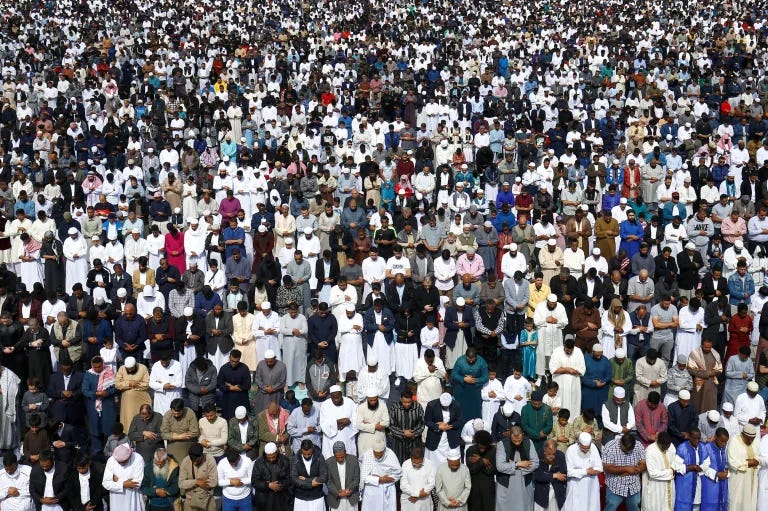
What would these men think if Tony Harrison told them about the value of freedom of speech, and how they should treasure it over their religion, which has “had its day”? Not much. The truth is, a liberal trying to gently persuade Muslims to give up Islam is like a man trying to gently rape a lion.
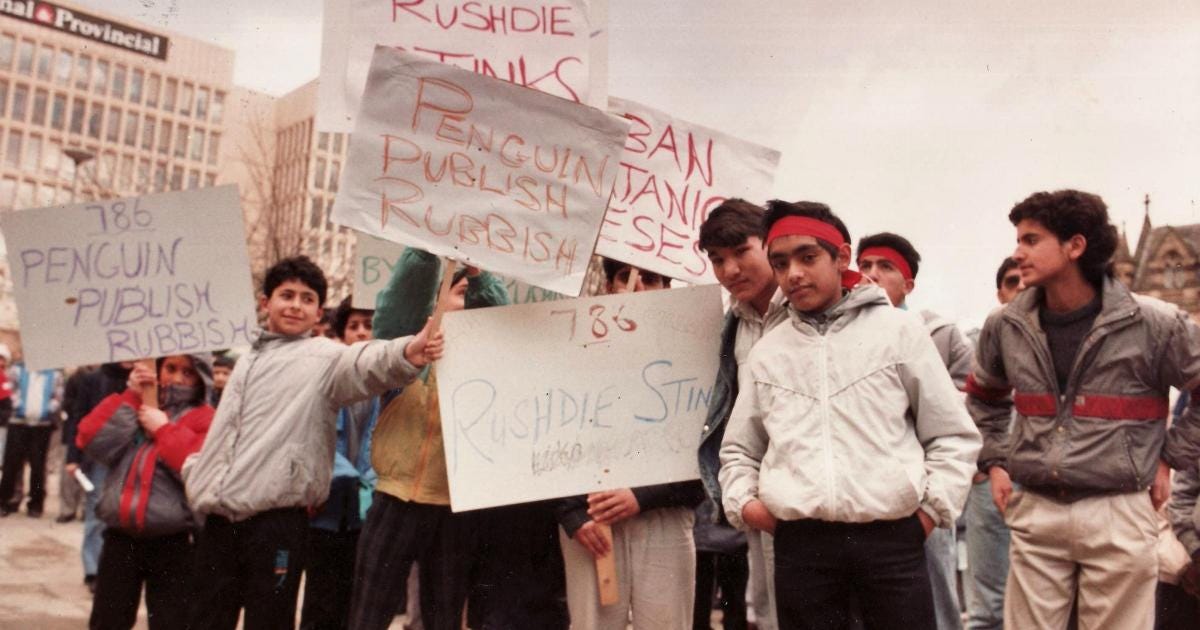
Another part of the poem deals - smugly - with the threat some outraged Muslims had made to boycott Penguin Books. Harrison thinks these Muslims would be shooting themselves in the foot, since their boycott would mean they couldn’t buy copies of a book very dear to them:
a book that Moslems ought to know is
published by Penguin - the Koran!So … when you impose your Penguin ban
the Koran’s on their list.
This is an incredibly weak and naive thing for Harrison to say. The first part shows the juvenile glee so typical of liberals when they think of some fatuous point and rush to think it a “winner”. Then he switches to a solemn tone, with the preachy moralising that was also beloved of “right on” liberals back then. (How ironic that this combination of traits - moralising while being naive - is exactly what these very people mocked Mary Whitehouse for.)
To examine the point that Harrison was making… Does he seriously think (he doesn’t, because he isn’t really thinking) that Muslims would have even the slightest difficulty obtaining non-Penguin copies of the Koran? Of course they wouldn’t. Therefore, what kind of “win” is it that some copies of it are by Penguin? Who cares?!
With the smug stealth of the “rebel” who knows the powerful are on his side, Harrison starts off railing against religious fundamentalism but casually pivots to the absolutism of “all religion’s had its day”. From the vantage point of 2026, this cavalier approach to very delicate subjects seems alarmingly reckless. But Harrison was speaking in a time when liberalism was ascendent and must have seemed invincible.
From that complacent - and therefore careless - position does Harrison also write the final stanza. It is surely worth studying.
I want to let [Salman Rushdie] know
I shall not cease from mental strife
nor shall my pen sleep in my hand
till Rushdie has a right to life
and books aren’t burned or banned.
This is a laudable sentiment, but again it is hopelessly naive and ultimately amounts to hot air.
In truth, Harrison has the freedom to write only because Muslims haven’t (yet) beheaded him, and the government hasn’t (yet) imprisoned him, and Communist thugs haven’t (yet) thrown him in a gulag, and Fascist thugs haven’t (yet) put him in hospital, and MI5 haven’t (yet) dragged him away in the dead of night.
I will not say that violence is necessary in life, however, those who cannot or will not use it are helpless against those who can and will, and for protection they must rely on some third party who may not remain reliable. This is the plight of the effete intellectual - like Harrison, like myself. Does writing have any effect in protecting one from violence? Do intelligence, imagination, kindness, talent, originality or noble intentions protect one from violence? I used to believe so, but eventually I realised that I believed it not because any evidence suggested it, but because I wanted to believe it - and this purged me of the delusion. If Harrison still believed, when he died in 2025, in the things he wrote in 1989, I can only surmise that, despite his advanced age, he still hadn’t gone through the painful process of evaluating his beliefs in the context of cold reality.
In 2026 we live in a Britain in which minorities proliferate by the year, and where (on current trends) Muslims are destined to rule. In 1989 this was not yet the case, so we should cut Harrison some slack for thinking back then that Muslims en masse could be swayed by kuffar verbiage. He was operating from a position of luxury compared to ours today. However, even then Muslims were present in Britain in numbers sufficient to force Salman Rushdie into hiding. Indeed, this was exactly what Harrison was responding to with his words. While their demographic predominance was not yet on the cards, their force as a group was already on full display - even while they were a tiny minority!
Harrison’s wording in that final stanza suggests that he realises the naivety of the sentiment. But he has nothing to offer that is less naive. In the end, all he can do is hope for the best. His awareness of this fact does not help him. What’s worse is that he lacks the moral fortitude, having become aware of this fact, to investigate alternatives. A cosseted intellectual, he sticks with his comfy delusions. The old cloisters of elitist Oxbridge which Harrison railed against might have produced complacency, but it is difficult to imagine that it rivalled the complacency of him and others promoted in the age of democracy. Having seen out the old order, they believed that their commitment to equality would see them through anything. They still believe this today. But I suspect that a man of Harrison’s sensitivity, in his darker moments, later realised the truth.
In the same year as all of this, 1989, Francis Fukuyama announced “the end of history”, first as a question then, three years later, as a declaration. In the Rushdie affair we see the factors that would eventually disprove the “end of history”. It is interesting that the thesis and its antithesis were born at the very same time.
If anyone is "gormless" its the dimwitted twits of the ruling class. It takes a special kind of idiotic chutzpah to complain about ignorant religious fundamentalists whilst packing the nation with them, piled high to the rafters. It's downright disgusting.
You’re much too charitable. I suspect he wouldn’t have changed his mind one bit. I have learned over the years that it is an absolutely pointless endeavour to try and persuade a liberal zealot to abjure his/her beliefs. It’s impossible (hence, I despise the “debate me, bruh!” mentality). In the liberal zealot’s mind progress has been preordained. These people truly believe that in time liberalism will without doubt prevail—because, in their view, it is peremptorily superior in terms of reason and morality. “Bumps in the road” will never deter or disabuse the liberal zealot. All the evidence in the world isn’t enough to convince the liberal crusader of abandoning his/her faith. Liberalism is a religion. The most powerful and insidious religion Man has ever created.