


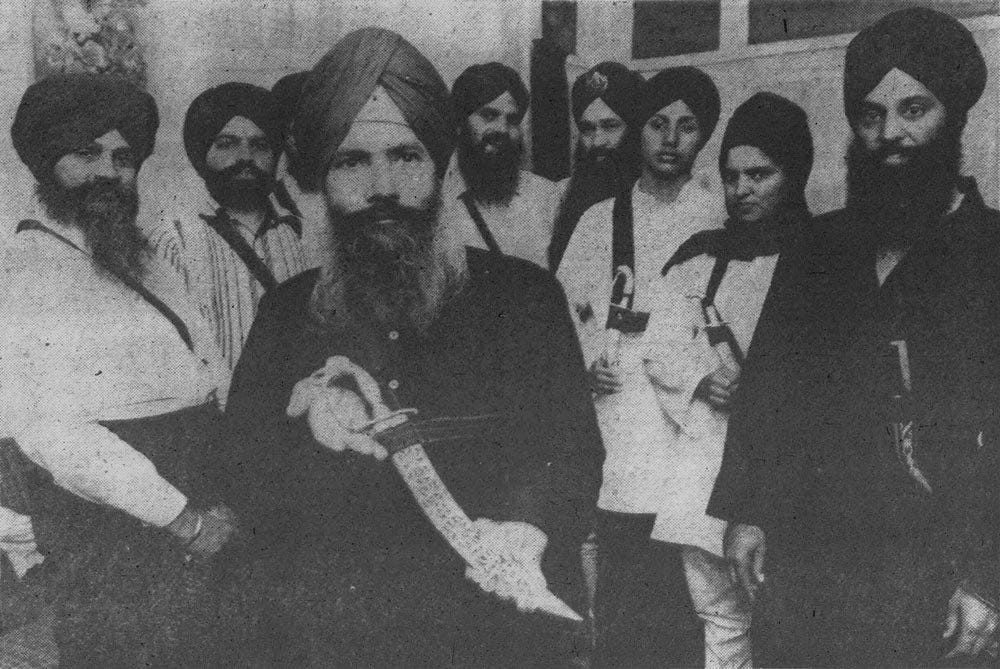
We have been told recently that a kirpan is a “small” Sikh ceremonial blade, usually about three inches long. But, looking through the newspaper archives (demonstrated by the photo above), British journalists and Sikhs themselves have historically used the word “kirpan” to refer to blades of many different sizes, so it is not surprising that, even today, nobody seems to be sure what the word actually means, or what exactly we have committed to tolerating on our streets. Is it a sword? Is it a dagger? Is it something even smaller than that? It seems to be all of these. Only this year (for reasons we will get to) has the media assured us that a kirpan is typically just three inches long.
Even before being officially legalised in 1988, the kirpan (in all sizes) was almost always tolerated in Britain. Various Sikhs were arrested for carrying one but charges were usually dropped, convictions only happened for long blades and even then not always, and in at least one instance the police actually apologised for the arrest. Interestingly, two of those arrested Sikhs were converts - one White in 1973 and one Black in 1982.
Where it was used in crime, it was only ever against other “Asians”. I found two examples. In Southall in 1983 a street fight occurred between two “Asian” gangs and involved the use of both short and long “kirpans”, among many other types of weapon. Dozens of men were injured. In Kent in 1987, a huge fight broke out inside a Sikh temple between “rival groups of Asians”, some with blades of 75cm in length. Four men were slashed.
But all of these victims were Asian, and the stories would only make local news. Most White British, the broad public, would be oblivious. Perhaps that is how the kirpan could be formally legalised, the very year after that fight in a temple. The Criminal Justice Act 1988 made it officially legal for Sikhs to carry a ceremonial blade in public. (This was later ratified by the Offensive Weapons Act 2019.)
Thereafter, there was the question of how much to tolerate it. In several cases in the 1990s and 2000s, it caused concern in schools and airports around the country. In every case, the answer found was to tolerate it more. It is remarkable how smooth the trajectory of acceptance has been. Then again, what school would forbid a pupil from carrying one around, when, given the legalisation, that would amount to the school breaking the law?
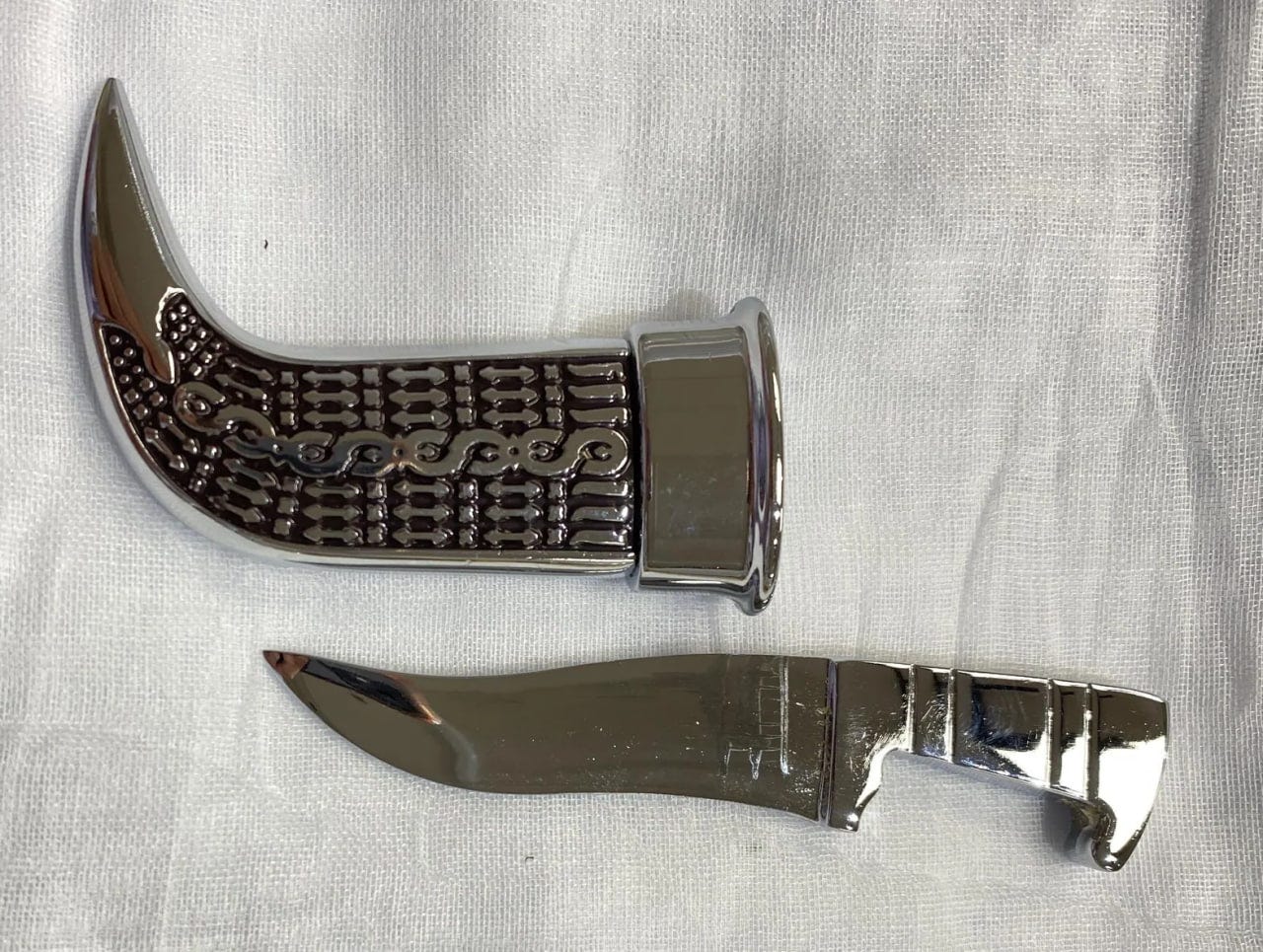
Though the law stipulates no size limit, the media assure us that most Sikhs only carry a small blade of about three inches in length. (Although it has to be said, even this could easily kill a man.)
But, as noted, even before this law, Sikhs carried much longer blades than that. Moreover, there is “mission creep”; if a law officially allows small blades, gradually longer blades will be tolerated, since nobody wants to take a non-white to task. I can’t find a single case after 1988 of a Sikh being arrested for carrying a kirpan of any length. Laws are used expansively against Whites, but diminishingly against non-whites. They have ever more leeway, we have ever less.
Thus, multiculturalism brings us scenes like this, even in Hazelbank Park in Northern Ireland:
If we read the actual text of both acts, we see that the legal exemption is not solely for Sikhs. In fact, Sikhs aren’t even mentioned. It applies to the adherents of any religion which requires the carrying of weapons. But of course, Sikhism is the only such religion. Some strands of modern Paganism and Wiccanism involve an athame, some strands of Buddhism a phurba, but there is no requirement to carry one around so neither qualifies for the legal exemption.
In theory, a bunch of White people could invent a religion which required them to carry swords around, and going by established law the British state would have to tolerate it. In practice, of course, this would never happen. Therefore, in practice what British law provides is a privilege for Sikhs that isn’t, and never would be, enjoyed by anyone else. Natives can only enjoy that privilege if they convert to the foreign religion of Sikhism.
This bizarre situation went on unchecked because very few people had any reason to be aware of it.
In the meantime, newspapers informed the British public that the kirpan is “a gold ceremonial sword symbolic of the struggle to maintain law and order and protect the innocent” and that it “represents freedom, protection, truth and justice”.
If they ever encountered a kirpan, it was probably in a formal setting of some kind. A Sikh brigadier gifted one to his former regiment in Penicuik. London police chief Sir Paul Condon was gifted one while visiting a Sikh temple. All very charming.
There just wasn’t much need for White British to know or care. I’d bet that 95% of them had never even heard the word “kirpan” before May 2026.
Then news broke of a criminal trial of a young Sikh, Vickrum Singh Digwa, who had killed a White teenager, Henry Nowak, using a ceremonial blade. Among other things about this case, White people were outraged to hear for the first time about the “religious exemption for Sikhs”, one law for us and another for them, British law giving them more freedoms than us - the natives! For many it was a perfect example of “two-tier Yookay”, even though the law goes back to 1988.
It was a bit ironic, because in fact Digwa was convicted not only of murder but of “possessing a bladed article in a public space”. The religious exemption didn’t help him. Why? Because he used an 8” pesh-kabz which the court ruled was surplus to his religious obligations, which were already fulfilled by the much smaller kirpan he wore around his neck and did not use in the murder.
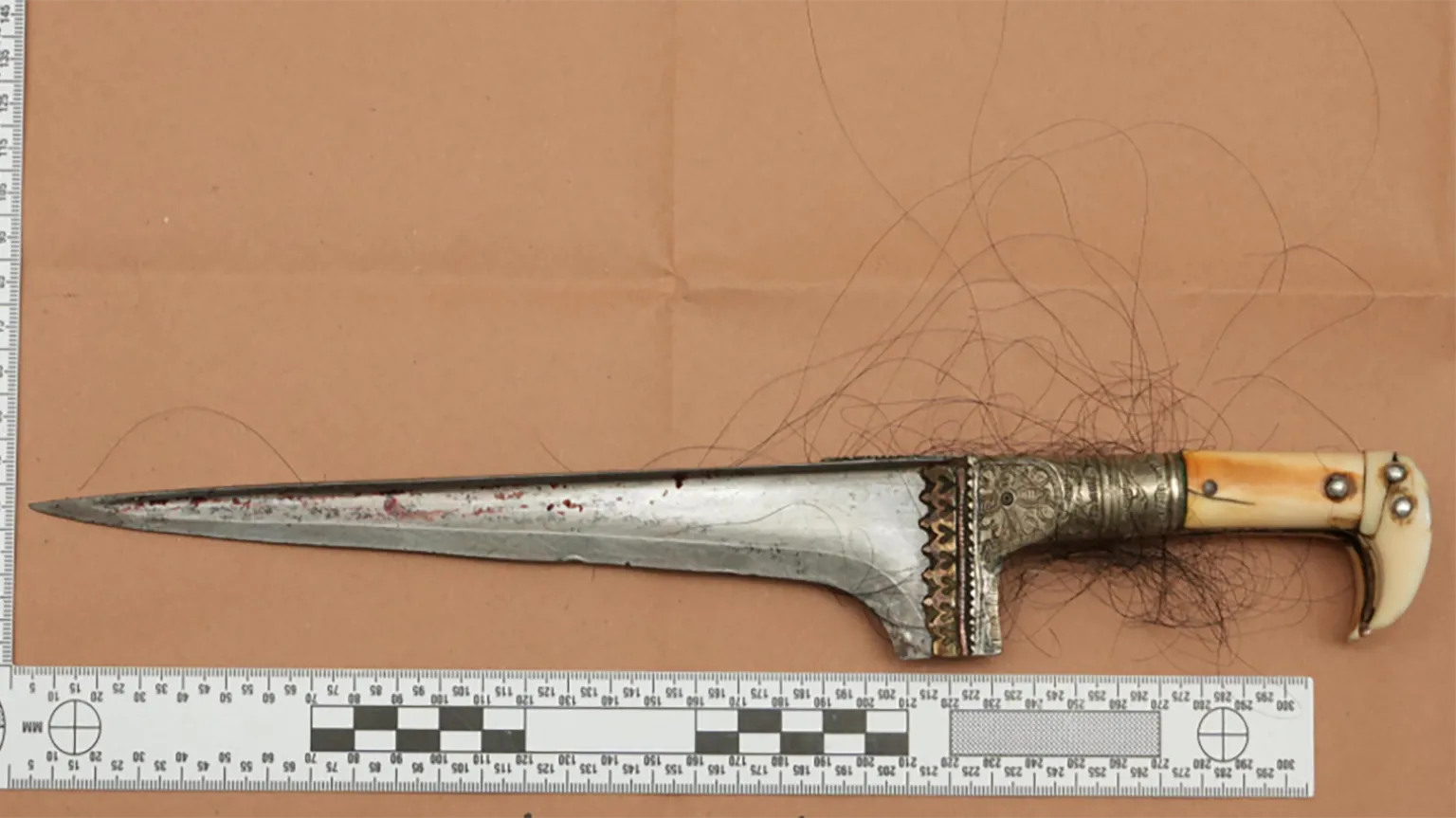
So, technically, the public outrage about the religious exemption was unnecessary. But not really, because, if not for that exemption, Digwa would have got a longer prison sentence. Moreover, if not for the exemption, police would surely have taken an interest in a young man walking around with an 8” blade hanging from his waist, as Digwa was in the habit of doing every day. Sure, in combination with the small kirpan, the pesh-kabz was still technically illegal, but nobody knew this because nobody knows much about foreign cultures, especially about how they intersect with boring legal provisions. A non-Sikh walking around with the same weapon would be arrested immediately. Digwa wasn’t, because he is a Sikh.
Moreover, if anyone had claimed that his pesh-kabz was illegal, Digwa could have countered, saying it is required for his religious obligations because he is a member of the Nihang order. Even after Digwa’s conviction, any Nihang Sikh could still use that defence. And how could we Whites disagree? What do we know about their religious obligations? Had you even heard the word “Nihang” before now? I certainly hadn’t. We are tourists to their culture, and disinterested ones at that, while by contrast they can claim to be total citizens of our nation, every bit as integrated and invested in its ways as we are.
Despite these many nuances, the Digwa trial has prompted demands for the religious exemption to be abolished. The phrasing is typically “ban the kirpan”, even though abolishing the exemption would not “ban” it, only prohibit it being carried in public.
There are numerous reasons why people want this.
Some want ethnic revenge against Sikhs collectively for the Nowak murder.
Some are outraged that Sikhs have a freedom denied to the rest of us. They want equality under the law, one rule for all, etc. But if that argument is used, progressives will smugly explain that, in fact, Sikhs don’t have more freedoms than us, because the exemption applies to anyone whose religion has this requirement. In any case, if the goal is “one law for all”, I’d say the better way is to increase freedom for non-Sikhs rather than reduce it for Sikhs: let anyone carry such a knife, as used to be the case. We would still be protected by all the laws around assault, murder, etc. should a knife be used offensively (laws which, incidentally, apply to Sikhs today). I also think there is something petty, spiteful and feministic about removing weapons from people, defanging them. I think it would be more honourable for us to masculinise ourselves than to emasculate this other group. Having said that, I also don’t agree with “one rule for all”; this is our homeland, so if anything we should have more rights than minorities.
Some just want a safer Britain. They are outraged that the state allows the threat of kirpan-enabled Sikhs in their midst. But, if that argument is used, Sikhs will respond with statistics. And it genuinely is an extremely rare threat; Henry Nowak is, as far as I can tell, the first White Brit who has ever been killed with a Sikh ceremonial blade. But as for the idea that a ban would make us all safer… well, what about the argument, long-cherished on the Right, that “guns don’t kill people, people do”? And would it make us safer? Is it safer to live amongst kirpan-enabled Sikhs, or amongst Sikhs enraged at your emasculation of them and your obliteration of their culture? I honestly don’t know the answer. At any rate, I can understand why people think a ban would make us safer; it would certainly have made Henry Nowak safer. But then there is another question: do we really want safety at the expense of liberty, like the awful middle-aged harpies who want digital ID and censorship for the sake of “safety”?
For other people, the argument is that Sikhs should “become more British”, and an obvious obstacle to that is their ancestral habit of carrying a ceremonial blade. They want Sikhs to be forced to relinquish their weird foreign customs. This argument is virtually identical to that for banning the burka: it would force these foreigners to integrate into mainstream British culture. Civic nationalists see that as both possible and desirable.
I don’t.
I want these people - Muslims, Sikhs, Hindus and non-white Christians and Atheists - to leave Britain. Whether they leave by choice or by law, I don’t care. I am tired of civic nationalists deluding themselves that any other course will preserve Britain. In that regard, banning the behaviours of our dusky friends is effectively just papering over the deep cracks in our multicultural crisis. It will not make them integrate to any great degree, but even if it did, that would be profoundly damaging to our people’s survival.
I also doubt that a ban on the kirpan (or the burka) would be enforceable. Would Sikhs abide by it? Would the modern British police have the guts to check?
All of those reasons are why I made this tweet.
Many replies said that I had missed the point. And indeed I had. In my rush to counter-signal the deluded civic nationalists who have thwarted proper nationalism in Britain for decades, I overlooked the fact that the policy they were advocating might actually have my desired effect, not theirs. In other words, banning the kirpan might cause Sikhs to leave Britain more than it would cause them to integrate.
It is very difficult to know because almost every Western country has more or less the same legal exemption as Britain. The only exception I can find is Italy, which forbids carrying kirpans in public, of any length. Italy has about 220,000 Sikhs (0.37% of its population) and that number is growing fast. That they remain in Italy suggests that they are willing to tolerate the ban, which also means it is not enough to make them self-deport.
In dealing with this problem we should not give in to our lower drives. We should try to be wise and to think of the long term. My positions:
the civ-nat desire to “force” foreigners to integrate is crude, futile and, more importantly, genetically self-defeating for us
the eth-nat desire to antagonise Sikhs is short-sighted, because if conflict ensues the regime is on their side, not ours
the eth-nat desire to incentivise Sikhs to self-deport is sensible
With all of that in mind, should we “ban the kirpan”? Probably.
If nothing else, it would progress things, bringing us closer to the point where we can all openly admit that multiculturalism doesn’t work. Once that is admitted, we can begin deciding how we are going to separate.
The special privileges enjoyed by Sikh people originally had nothing to do with Liberalism but were acknowledgement of the long and special relationship between the Sikhs and the Crown in service of the Raj. Since these have morphed into Liberal “rights” and Sikhs have adopted the anti wacist language of the regime Sikh culture has rapidly deteriorated. Sikh faces are present on almost every rape gangs group mug shot. Our centuries long alliance with them must be considered dead and buried.
Being English has, amongst other things, meant being armed and ready to defend your life, your family and your property.
These rights have been surrendered to a state which by every objective measure od either s miserable failure or a sinister conspiracy.